Why don't my wearables catch the changes my doctor finds?
Consumer wearables provide helpful health trends, but they often miss subtle changes that clinical-grade medical devices are designed to detect. Learn the key differences.
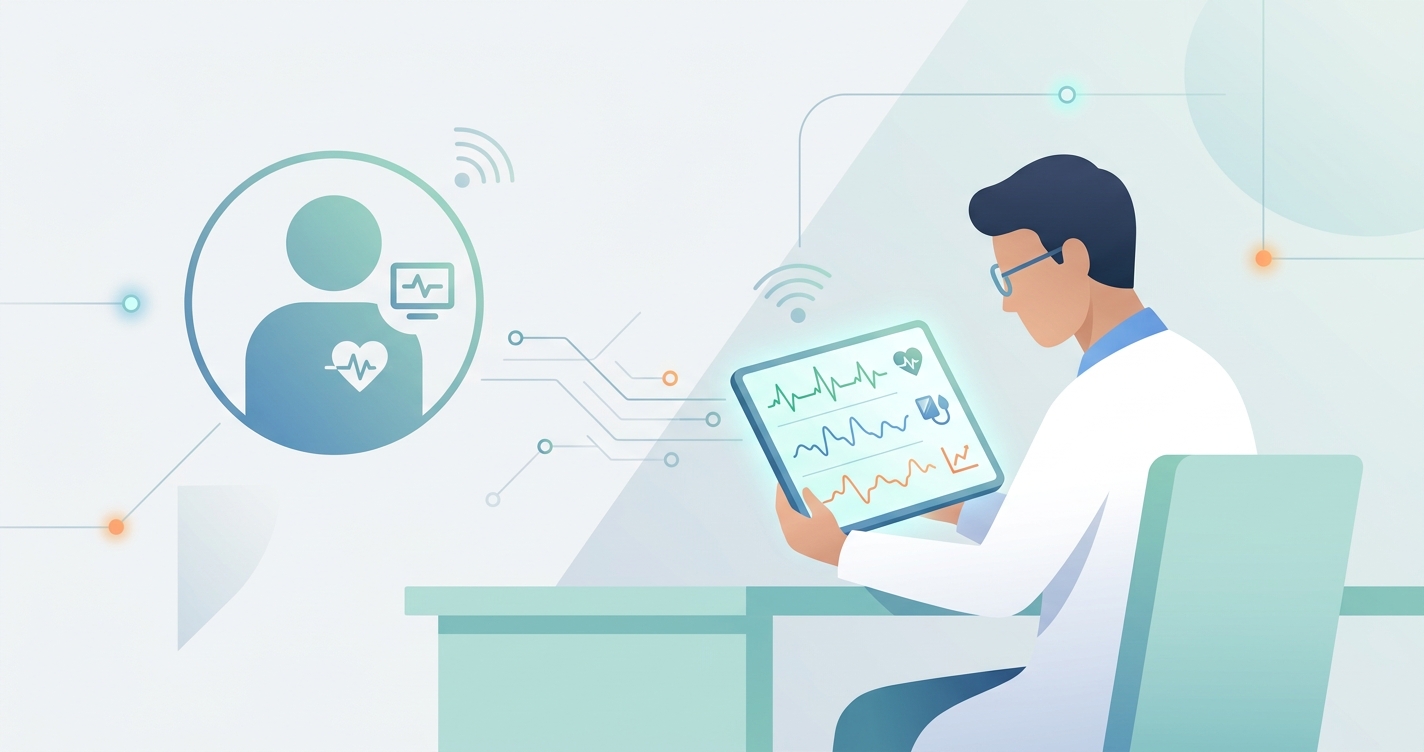
It's a common and frustrating experience for people managing a chronic condition. You diligently track your health with a popular smartwatch or fitness band, but when you visit your doctor, their measurements show a different picture. A change in your condition has occurred that your wearable completely missed. This discrepancy isn't a failure of your device; it's a fundamental difference in purpose and technology between consumer gadgets and the tools used in clinical practice. Understanding this gap is crucial for patients and for the healthcare organizations that support them.
"A study of consumer-wearable devices found that while useful for tracking trends, their heart rate measurements had error rates ranging from 2.5% to over 20% during different types of activity compared to a gold-standard EKG." (Shcherbina et al., PLOS One, 2017)
Why wearables miss changes doctor finds
The core reason that consumer wearables miss changes doctor finds is that they are not designed to be medical devices. Their primary function is to provide motivational health and fitness tracking for the general population. Clinical tools, on the other hand, are built for diagnostic accuracy and sensitivity to detect subtle physiological changes that signal a shift in a patient's condition. This divergence in purpose leads to significant differences in sensor technology, data processing, and how the information is collected and interpreted. While a consumer device might track daily steps and estimated sleep, it lacks the precision required for a care manager to make a high-stakes clinical decision, such as adjusting medication for a heart failure patient.
The sensors in most wrist-worn wearables use light-based photoplethysmography (PPG) to estimate heart rate and other metrics. Research from the University of California, San Francisco (UCSF) has highlighted that while PPG is convenient, its accuracy can be affected by skin tone, motion, and device fit (K. Y. S. Lee et al., 2020). A clinical-grade device, like an ECG patch or a blood pressure cuff, measures the body's signals directly, providing a more accurate and reliable data point. This difference is why a wearable might show a steady heart rate, while a doctor's EKG detects an arrhythmia. The wearable's algorithm is designed to smooth out data and provide a clean trendline, a process that can inadvertently mask the very "noise" a clinician needs to see.
| Feature | Consumer Wearables (Smartwatches, Fitness Trackers) | Clinical Monitoring Devices |
|---|---|---|
| Primary Purpose | General wellness, fitness, and lifestyle tracking. | Diagnosis, management, and treatment of medical conditions. |
| Sensor Technology | Primarily optical (PPG), accelerometers. | Often direct measurement (e.g., ECG, SpO2, blood pressure cuffs). |
| Data Frequency | Periodic or user-initiated spot checks, often averaged over time. | Continuous or high-frequency interval measurements for clinical analysis. |
| Regulatory Oversight | Generally not submitted for rigorous regulatory review as medical devices. | Subject to review and clearance by regulatory bodies for safety and efficacy. |
| Data Interpretation | Focus on trends, estimates, and user-friendly summaries. | Focus on precise, raw data points for diagnostic interpretation. |
Further complicating the picture are issues of adherence and data consistency.
- Intermittent Use: Patients may forget to wear their device, let the battery die, or take it off for periods, creating gaps in the data record.
- "Spot" vs. "Continuous" Data: Many wearable metrics are based on spot checks, taken whenever the user decides to initiate a reading. This is fundamentally different from a clinical tool designed for continuous or high-frequency automated readings, which can reveal trends that spot checks miss entirely.
- Lack of Clinical Context: A wearable might report a high heart rate, but it doesn't know if the user is exercising or experiencing a medical event. This lack of context makes the data less actionable for a provider.
Industry applications for chronic care management
For value-based care organizations, ACOs, and chronic care management (CCM) programs, relying solely on consumer wearable data presents a significant challenge. The data is often not reliable enough for proactive intervention or accurate risk stratification. This is why many organizations are exploring remote monitoring technologies built for the specific needs of managing chronic conditions like heart failure, COPD, and diabetes.
Augmenting clinical workflows
Instead of replacing clinical judgment, the goal of remote monitoring is to augment it with reliable, frequent data. When a care manager receives a stream of high-fidelity data from a patient's home, they can identify subtle deteriorations before they become acute episodes. This allows for earlier intervention, such as a medication adjustment or a telehealth visit, potentially preventing a costly hospital admission.
Addressing patient adherence
A major hurdle in any remote monitoring program is patient adherence. The "device fatigue" associated with wearables, cuffs, and fingersticks is a real barrier. This is driving interest in contactless monitoring solutions that can capture vital signs without requiring the patient to wear a device or manually take a measurement. By reducing the burden on the patient, these systems can achieve higher long-term adherence, providing a more complete and useful dataset for the care team.
Current research and evidence
The medical and scientific communities are actively studying the gap between consumer and medical-grade devices. A 2019 study in the Journal of Medical Internet Research by Bent and colleagues evaluated the heart rate accuracy of four popular wrist-worn devices against a standard electrocardiogram. They found that while performance was acceptable at rest, accuracy decreased significantly with physical activity. This reinforces the idea that the context of data collection matters immensely.
Another critical area of research is in heart rate variability (HRV), a key metric for assessing cardiovascular health and autonomic function. A paper from the European Society of Cardiology (Georgiou et al., 2018) notes that while many wearables claim to measure HRV, the methods and algorithms used are not standardized, making it difficult to compare data across devices or to use it for clinical decision-making. The consensus is that while wearables are promising for raising patient awareness, they are not a substitute for medical-grade monitoring in a clinical setting.
The future of remote patient monitoring
The future of remote monitoring for chronic conditions lies in systems that bridge the gap between convenience and clinical reliability. As technology evolves, the focus is shifting from wearable gadgets to ambient, contactless solutions that integrate seamlessly into a patient's daily life. These technologies can gather essential vital signs like heart rate, respiratory rate, and blood pressure without any action required from the user, dramatically improving adherence and providing a continuous stream of data. For chronic care programs, this evolution represents a move toward more proactive and preventative care models, powered by data that is both consistent and trustworthy.
Frequently asked questions
Why is my wearable's heart rate different from the one at the doctor's office? Your wearable likely uses an optical PPG sensor to estimate heart rate, which can be affected by fit, movement, and skin tone. Your doctor uses an electrocardiogram (ECG) or a pulse oximeter, which are more direct and accurate methods of measurement. The wearable is designed for trend tracking, while the doctor's tool is for diagnostic accuracy.
Can I use my smartwatch for managing my chronic condition? While a smartwatch can be a helpful tool for motivation and tracking general activity, it should not be used as a primary tool for managing a chronic condition. The data is generally not precise enough for your care team to make clinical decisions. Always follow your doctor's recommendations for home monitoring.
What is the difference between a consumer wearable and a medical device? The main differences are purpose, accuracy, and regulatory oversight. Consumer wearables are for general wellness. Medical devices are designed, tested, and regulated for the purpose of diagnosing and managing specific medical conditions, and they are held to a much higher standard of accuracy and reliability.
As this space evolves, Circadify is developing solutions to provide clinical teams with reliable, contactless data to support chronic care management programs. To learn more about how to build a CCM program with next-generation technology, see our information on solutions for Chronic Care Management.