What Chronic Care Management Technology Does in 2026
A plain-language guide to what chronic care management technology tracks in 2026 and why daily vitals data drives better outcomes for value-based care programs.
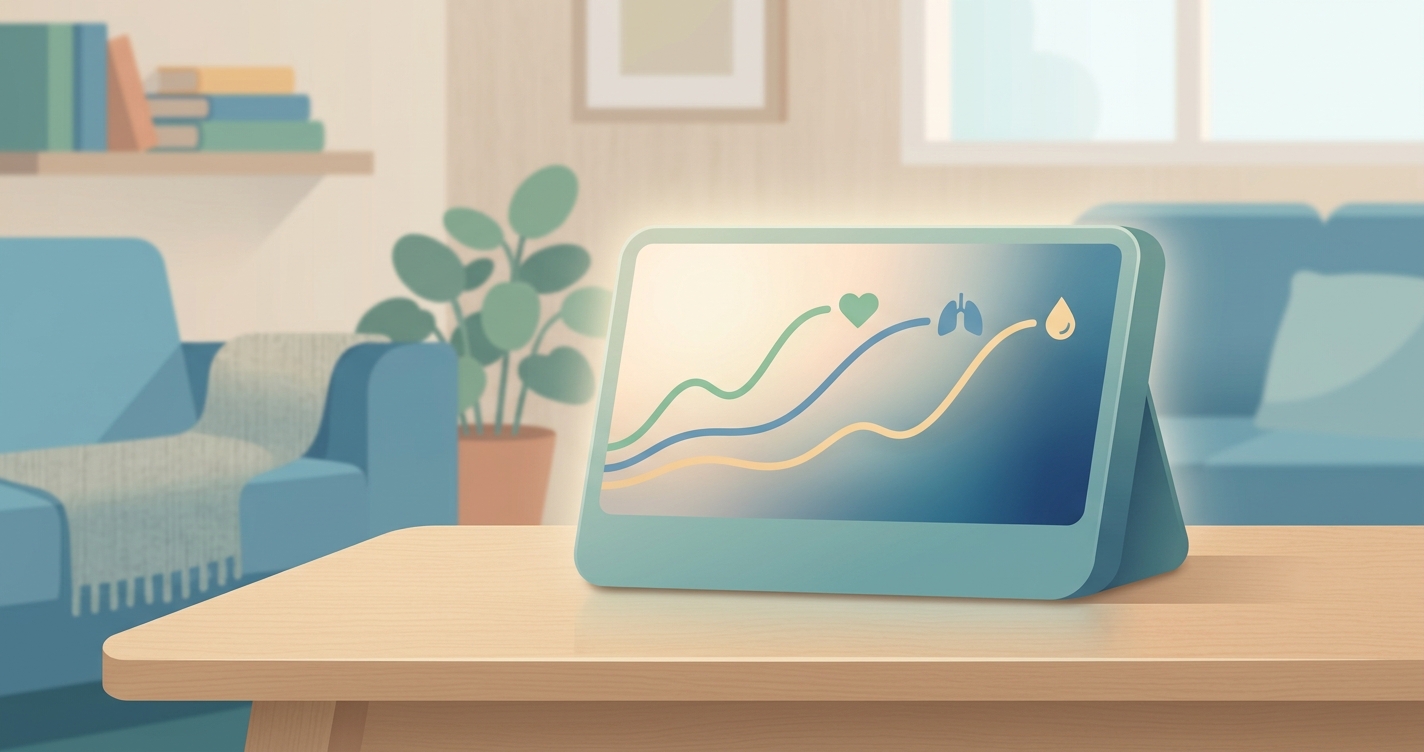
Most leaders evaluating chronic care programs in 2026 are not asking whether remote monitoring works. The evidence settled that question years ago. The harder question is what the software actually does day to day, what data it collects, and whether that data changes outcomes or simply fills a dashboard nobody reads. Chronic care management technology has matured from a billing convenience into the operational core of how value-based care organizations manage cost and risk across large panels of patients with heart failure, COPD, and diabetes.
This guide explains, in plain language, what modern chronic care management technology tracks, how the pieces fit together, and why the frequency of vitals data has become the variable that separates programs that lower hospitalizations from programs that only generate reports.
A meta-analysis of remote patient monitoring in heart failure found a pooled 20 percent relative reduction in heart-failure hospitalizations (risk ratio 0.80), with some structured programs cutting 30-day readmissions by roughly half. The signal is consistent across study designs.
What chronic care management technology actually does
At its simplest, chronic care management technology connects three things: a patient at home, a stream of health data, and a care team that can act on it. Older programs treated that connection as a monthly phone call plus a billing claim. The 2026 version is built around continuous or near-daily data so that a care manager sees a problem forming before it becomes an emergency department visit.
A modern platform handles four jobs at once:
- Capturing vitals and symptom data from the patient, ideally without forcing them to operate medical hardware every day.
- Turning raw numbers into trends and alerts so a nurse is not reading every reading manually.
- Routing flagged patients into a worklist that prioritizes who needs attention first.
- Documenting the time, contact, and clinical reasoning required to bill Medicare CCM and remote monitoring codes correctly.
The first job is where device fatigue quietly kills programs. A patient who has to use a cuff, a pulse oximeter, a scale, and a glucometer every morning tends to stop within a few weeks. That is why contactless and low-friction capture methods have moved to the center of the conversation. The most useful data is the data that actually gets collected, not the data the protocol assumes.
The reason the market is expanding so fast reflects this shift. Analysts at Grand View Research and several other firms place the remote patient monitoring market somewhere around 30 billion dollars or higher in 2026, with chronic disease management as the leading application segment, driven by an aging population and reimbursement support in the United States.
CCM software features compared by data frequency
Not all chronic care management technology collects data the same way, and the difference matters more than most feature lists suggest. The table below compares common approaches by how often they actually produce usable data, the burden they place on patients, and where they tend to fit in a value-based care technology stack.
| Approach | Typical data frequency | Patient burden | Best fit |
|---|---|---|---|
| Monthly phone-based CCM | Once per month | Very low | Care coordination and medication review |
| Device-based RPM (cuff, scale, oximeter) | Daily, when adherence holds | High over time | High-acuity patients who tolerate devices |
| Implantable hemodynamic monitoring | Continuous | Requires a procedure | Advanced heart failure, narrow population |
| Contactless daily check-ins | Daily, low drop-off | Very low | Broad panels across multiple conditions |
A few patterns hold across most programs:
- Monthly contact alone rarely catches a flare in time, because heart failure and COPD exacerbations build over days, not weeks.
- Device-based monitoring produces excellent data while adherence lasts, but adherence is the failure point, not the sensor.
- Continuous implantable monitoring shows the strongest hospitalization reductions in trials, yet applies to a small slice of patients.
- The practical question for a large panel is how to get near-daily data without asking every patient to become a part-time technician.
Why daily vitals data matters for outcomes
The clinical logic is straightforward. Chronic conditions deteriorate on a curve, and the earliest part of that curve is usually silent. A heart failure patient retaining fluid often feels close to normal for several days while weight, heart rate, and respiratory patterns drift. A COPD patient entering an exacerbation may compensate quietly before breathlessness becomes obvious. By the time the patient feels sick enough to call, the intervention window has narrowed and the cheapest options are gone.
Daily data shortens the gap between deterioration and response. That is the mechanism behind the readmission reductions reported in the literature. A program that sees a three-day trend can adjust a diuretic dose or schedule a visit. A program that learns about the problem at the next monthly call learns about it from the hospital discharge summary.
What gets tracked and why
- Weight and fluid trends for heart failure, where a multi-day gain often precedes decompensation.
- Heart rate and rhythm patterns that signal cardiovascular strain.
- Respiratory rate and oxygen-related signals relevant to COPD flares.
- Blood pressure trends for hypertension, the most common condition any program manages.
- Glucose patterns and symptom reports for diabetes, where post-meal drift can stay invisible to the patient.
The value is not any single reading. It is the trend line, and trend lines require frequency.
Industry applications across a value-based care technology stack
Chronic care management technology does not sit alone. It feeds the broader value-based care technology stack that organizations use to manage total cost of care.
Accountable care organizations and CCM companies
For ACOs and dedicated CCM companies, the platform functions as an early-warning layer across a risk-bearing panel. The goal is to concentrate scarce nursing time on the patients most likely to deteriorate this week, rather than spreading equal effort across everyone. Contactless daily check-ins make that triage possible at scale because they keep the data flowing even from patients who would abandon a device.
Health systems and cardiology groups
Hospital-affiliated programs use the same data to manage transitions of care after discharge, the period when readmission risk peaks. Here the technology connects to the electronic record and quality-reporting workflows so that documented monitoring also supports quality-measure performance.
Multimorbidity management
Most chronic patients carry more than one condition. A single low-friction capture method that covers heart failure, COPD, hypertension, and diabetes at once reduces the operational mess of running four separate device programs for one person.
Current research and evidence
The strongest evidence base remains in heart failure. A meta-analysis summarized across multiple trials reported a pooled risk ratio near 0.80 for heart-failure hospitalizations with remote monitoring, meaning roughly a 20 percent relative reduction. The same body of work shows noninvasive monitoring landing around a risk ratio of 0.83 and implantable hemodynamic monitoring closer to 0.72, indicating that more granular and continuous data tends to produce larger effects.
Program-level reports reinforce the trial data. Coverage in the American Journal of Managed Care has described structured remote monitoring programs cutting 30-day heart-failure readmissions by about half, and chronic care management studies have reported statistically significant reductions in heart failure hospitalizations. The consistent thread is that outcomes improve when monitoring is frequent enough to catch a trend and when a care team is structured to act on the alert.
It is worth being precise about what the evidence does and does not say. The literature supports frequent monitoring paired with responsive care management. It does not support the idea that collecting data alone changes anything. The technology is necessary but not sufficient; the workflow around it is where outcomes are won or lost.
The future of chronic care management technology
Three shifts are visible heading deeper into 2026. First, the burden problem is pushing the field toward contactless and ambient capture, because adherence has proven to be the real ceiling on device-based programs. Second, analytics are moving from simple threshold alerts toward trend-based and predictive flags that reduce false alarms and protect nursing time. Third, reimbursement and quality reporting are converging, so the same daily data that drives clinical decisions increasingly also satisfies billing and measure requirements.
The organizations that benefit most will be those that treat chronic care management technology as infrastructure rather than a feature purchase, and that design their care workflows around the data the technology can realistically collect every day, not the data a protocol wishes patients would provide.
Frequently asked questions
What does chronic care management technology track? Modern platforms track condition-specific vitals and symptoms such as weight and fluid trends for heart failure, respiratory and oxygen signals for COPD, blood pressure for hypertension, and glucose patterns for diabetes. The point is trend detection over time, not isolated readings, so frequency of capture matters as much as the metrics themselves.
Why does daily vitals data matter more than monthly check-ins? Chronic conditions deteriorate over days while patients often still feel normal. Daily data lets a care team intervene during that silent window, which is why frequent monitoring is associated with lower hospitalization and readmission rates in the research, while monthly contact alone often catches problems too late.
How does CCM technology fit into a value-based care technology stack? It serves as the early-warning and patient-engagement layer, feeding triage worklists, electronic records, quality-measure reporting, and billing documentation. In risk-bearing models it helps concentrate limited nursing capacity on the patients most likely to deteriorate, which supports total-cost-of-care goals.
Does the data alone improve outcomes? No. Evidence supports frequent monitoring combined with a care team structured to act on alerts. Data that nobody reviews or acts on does not change outcomes, which is why workflow design and manageable patient burden are as important as the underlying technology.
Circadify is addressing this space directly with daily contactless check-ins built to keep vitals data flowing without the device fatigue that stalls so many programs. Value-based care leaders comparing options can review the evaluation guide and program details at circadify.com/solutions/chronic-care-management.