Wearable Fatigue in Chronic Disease Patients: Why Contactless Monitoring Wins
A research-based look at why wearable fatigue chronic disease patients experience is pushing chronic care leaders toward simpler contactless monitoring models.
Wearable Fatigue in Chronic Disease Patients: Why Contactless Monitoring Wins
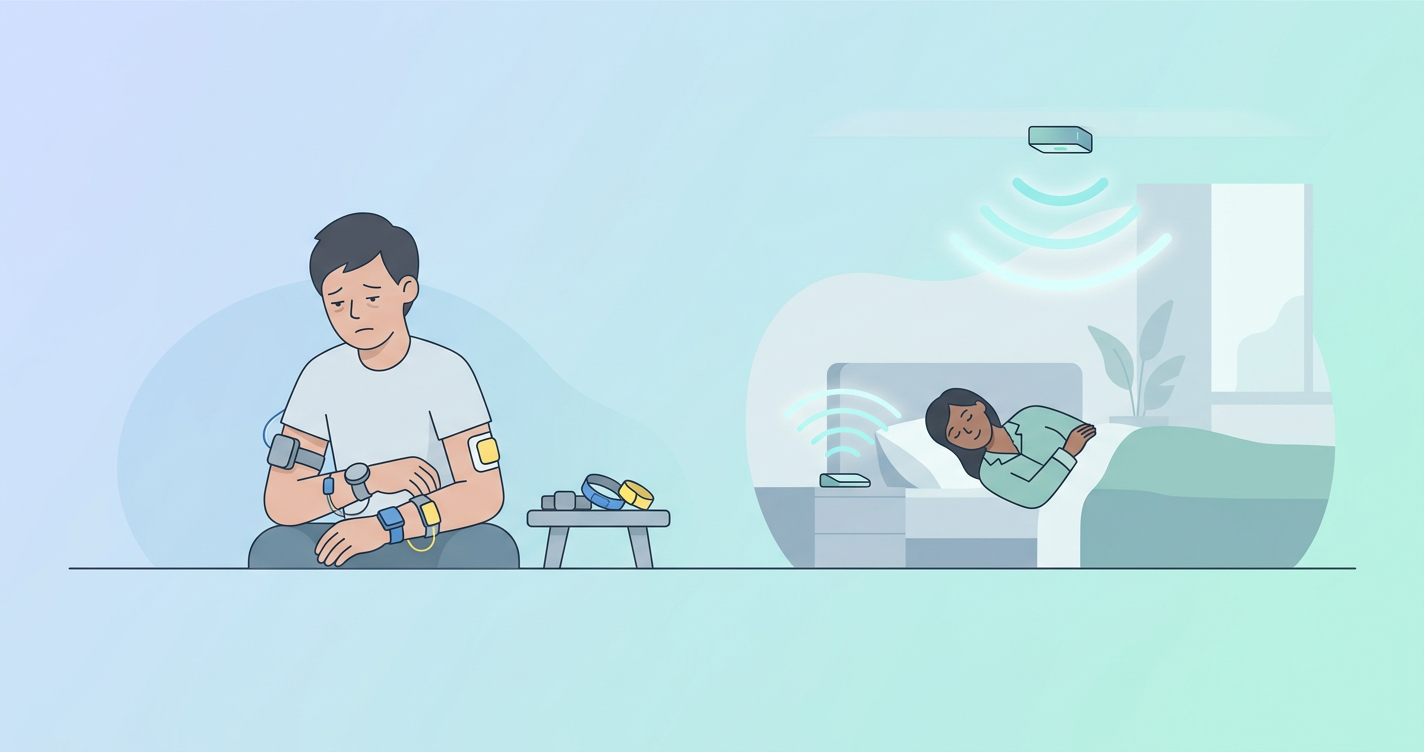
Wearable fatigue chronic disease patients experience is becoming one of the quiet reasons remote monitoring programs stall after launch. Care teams may buy solid hardware, design sensible escalation rules, and still find that months later the patient is no longer charging the device, no longer wearing it consistently, or no longer wants one more health gadget on the nightstand. For chronic care management companies, ACOs, and value-based care operators, that matters more than the marketing around any single device category. The winning model is usually the one that patients will actually stick with over time.
"People with multiple chronic conditions account for 71% of all health care spending and 93% of Medicare spending." — Agency for Healthcare Research and Quality, Multiple Chronic Conditions Chartbook
Why wearable fatigue chronic disease patients report is a serious operating problem
The phrase sounds soft, but the consequences are not. In chronic disease programs, wearable fatigue usually means declining adherence after the novelty wears off. The patient may still like the care team and believe monitoring is useful, but daily life gets in the way. Devices need to be charged, synced, replaced, cleaned, remembered, and tolerated. For someone already managing medications, appointments, symptoms, and insurance paperwork, that burden adds up.
Kamei T., Kanamori T., Yamamoto Y., and Edirippulige S. reported in the Journal of Telemedicine and Telecare that wearable interventions in chronic disease management did not produce a significant overall improvement in adherence across the studies they reviewed. That finding is easy to gloss over, but it should make buyers pause. If the core promise is better longitudinal engagement, technology that does not reliably improve adherence may solve less than expected.
That does not mean wearables are useless. Some higher-acuity patients absolutely benefit from them. The point is narrower: chronic care programs often overestimate what a broad patient population will tolerate month after month.
| Monitoring model | What the patient has to manage | Common friction point | What the care team gets |
|---|---|---|---|
| Wrist wearable | Charging, wearing, pairing, comfort | Device abandonment after early enthusiasm | Frequent passive data when use stays high |
| Multi-device RPM kit | Several devices, instructions, storage, syncing | Setup burden and incomplete routines | Rich data for engaged users |
| Symptom-only outreach | Calls, texts, self-report | Subjective recall and uneven response rates | Lower operational burden but thinner signal |
| Contactless camera check-in | Brief scan on an existing phone or tablet | App familiarity and scan consistency | Lightweight repeatable signal without extra hardware |
That comparison matters because chronic care is not won by the technically richest workflow. It is won by the workflow that survives ordinary life.
Why contactless monitoring often outperforms wearables in chronic care
Contactless monitoring is attractive for a simple reason: it removes a category of burden. Patients do not need another object on their body, another charger in the house, or another device to remember before bed. A short camera-based check-in is not effortless, but it is easier to fold into a routine than wearing hardware indefinitely.
That is the economic story too. David I. Feldman, Spencer Reynolds, Sarine Babikian, Brian D. Stein, Jessica Schlicher, Eve Cunningham, Theodore Feldman, Randall Curnow, Jing Zheng, Puneet Budhiraja, and Marat Fudim reported in Mayo Clinic Proceedings: Innovations, Quality & Outcomes that a remote patient care program for Medicare patients with chronic disease was associated with a $1,302 reduction in total cost of care per patient per year and a 27% reduction in hospitalizations. The study was not about contactless monitoring specifically, but it reinforces a bigger point: chronic care programs create value when they can sustain enough patient participation to catch deterioration earlier.
If the barrier is device fatigue, then reducing the device burden is not a cosmetic improvement. It is the main operational lever.
A newer 2026 review in Frontiers in Digital Health on remote photoplethysmography for health assessment described rPPG as a low-cost, noninvasive way to estimate heart rate, respiratory rate, heart rate variability, hypertension risk, and related health outputs with standard cameras. That matters for chronic disease programs because it points toward a model that can gather useful repeatable signal with tools patients already own.
Where wearable fatigue shows up first
The pattern is usually visible long before a patient formally drops out.
- missed daily readings start to cluster around weekends or travel days
- support calls shift from clinical questions to charging and syncing problems
- patients with multiple conditions start prioritizing medications over monitoring tasks
- caregivers report that the device feels like one more reminder of illness
- staff spend more time rescuing the workflow than acting on the data
This is why the patient experience matters so much. The cleaner the workflow, the more likely the data stream remains usable in month three and month six.
For related reading, this site has already looked at Camera-Based Monitoring for Multiple Chronic Conditions and What Is the Patient Experience of Daily Contactless Health Checks?. Both point to the same practical issue: low-friction routines tend to age better than hardware-heavy ones.
Industry applications where contactless monitoring has the clearest edge
Heart failure programs
Heart failure patients often need repeat monitoring, but they are also the patients most likely to feel overloaded by treatment burden. A quick contactless check-in can fit into a morning routine more easily than another persistent wearable requirement, especially in programs trying to scale beyond the sickest subset.
COPD and respiratory care
COPD programs need regular visibility without creating another source of patient frustration. Contactless models can support lighter-touch daily engagement for people who may already be dealing with inhalers, oxygen equipment, or frequent care coordination.
Diabetes and multimorbidity populations
Patients with diabetes often have more than one chronic condition, which makes device overload more likely. A contactless workflow works well when the operational goal is repeat participation, trend visibility, and easier outreach rather than maximum hardware density.
Value-based care organizations and ACOs
These buyers care about total cost of care, panel coverage, and preventable utilization. They are usually better served by a monitoring model that broadens participation than by a narrow model that produces beautiful data from a shrinking group of adherent users.
Current research and evidence
The evidence base is still developing, but several findings already point in the same direction.
Kamei and colleagues' systematic review found that wearable interventions in COPD, diabetes, and cardiac disease did not show a significant overall adherence improvement. That is a useful corrective to the assumption that giving patients a wearable automatically fixes engagement.
The AHRQ Multiple Chronic Conditions Chartbook remains the best reminder of why this matters operationally. Chronic disease populations account for most healthcare spending, so even small improvements in adherence and early intervention can move utilization in meaningful ways.
The remote patient care study led by Feldman and colleagues is also important because it links sustained chronic disease monitoring to lower inpatient use and lower overall cost. For buyers, that is the real question. Monitoring is not valuable because it is modern. It is valuable if it helps teams intervene earlier and avoid expensive deterioration.
The 2026 rPPG review adds the technology angle. It suggests that standard camera-based measurement is maturing into a practical infrastructure layer for repeated health assessment. That does not mean every program should replace every wearable tomorrow. It does mean the industry now has a plausible alternative for patients who are tired of carrying the whole program on their wrists.
Avalere Health's Medicare analysis offers one more important signal: nearly 1.3 million Medicare beneficiaries received chronic care management services in 2023, up 23.4% from 2022. CCM is not a niche anymore. As the market grows, the operational winners will be the teams that keep participation high without making the patient workload heavier.
What chronic care leaders should compare before choosing a monitoring model
Too many teams compare features instead of comparing behavior.
They should be asking:
- what percentage of enrolled patients are still participating at 30, 90, and 180 days
- how much staff time goes to technical troubleshooting versus clinical outreach
- whether the monitoring routine fits patients with more than one chronic condition
- how often caregivers need to step in to keep the workflow going
- which model produces enough signal to change care decisions without exhausting the patient
That last question is the one I keep coming back to. Chronic care programs are full of technically impressive tools. The more important test is whether the patient can live with the tool for long enough to matter.
The future of wearable fatigue chronic disease patients are dealing with
I do not think the future is "no wearables ever." Some patients will still need connected cuffs, scales, oximeters, or disease-specific hardware. But for broad chronic care populations, the center of gravity is likely to move toward lower-friction monitoring.
Three shifts look likely.
Segmented monitoring will replace one-size-fits-all RPM kits
Higher-risk patients will keep richer device stacks. Broader chronic populations will get simpler, lighter check-ins built around existing phones and tablets.
Adherence-adjusted ROI will matter more than feature checklists
Buyers will stop rewarding platforms just for the amount of data they can theoretically collect. They will care more about what percentage of patients are still producing usable data months later.
Contactless workflows will become part of chronic care infrastructure
Camera-based monitoring is increasingly attractive because it fits chronic care management instead of fighting it. It can support repeated engagement without asking every patient to become a hardware manager.
Frequently asked questions
What is wearable fatigue in chronic disease monitoring?
Wearable fatigue is the drop in engagement that happens when patients get tired of charging, wearing, syncing, and maintaining monitoring hardware over time.
Why does contactless monitoring help reduce wearable fatigue?
It removes the device from the patient's body and often uses a phone or tablet they already own. That lowers day-to-day burden and can make regular check-ins easier to sustain.
Are wearables still useful for some chronic disease patients?
Yes. Some patients need device-based monitoring, especially in higher-acuity settings. The issue is that not every chronic care population will maintain wearable use long enough for the program to scale efficiently.
Why do value-based care leaders care so much about patient burden?
Because patient burden affects adherence, and adherence affects whether monitoring leads to earlier intervention, lower hospital use, and better program economics.
The big takeaway is straightforward: wearable fatigue chronic disease patients experience is not a side issue. It is one of the main reasons monitoring programs underperform after launch. That is why lower-friction approaches are getting so much attention. Solutions like Circadify's chronic care management platform are being built around quick camera-based check-ins that fit chronic care workflows without adding another device to the patient's life.