How to Scale a Chronic Care Monitoring Program
An analysis of how health systems and CCM operators scale a chronic care monitoring program through workflow design, staffing models, low-friction patient engagement, and reimbursement alignment.
How to Scale a Chronic Care Monitoring Program
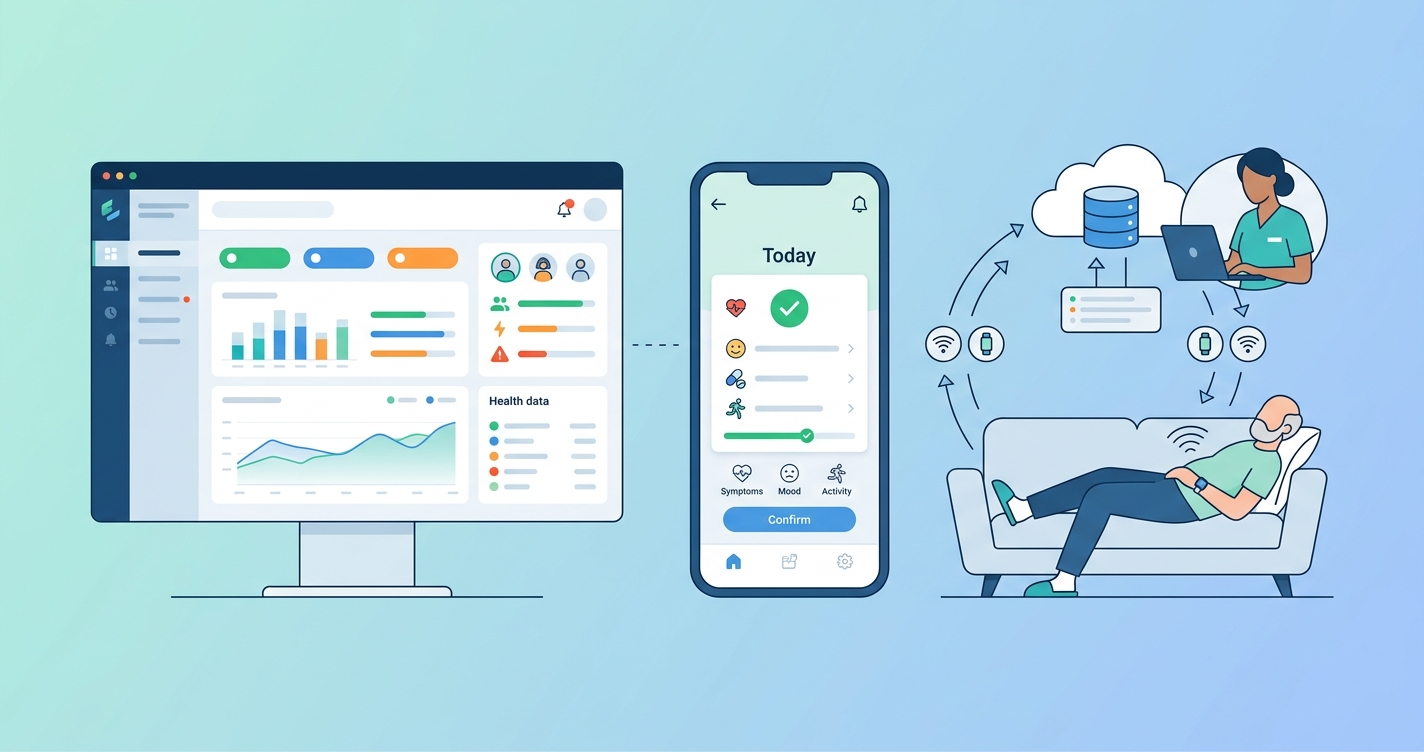
To scale chronic care monitoring program operations, most organizations eventually discover the same thing: the bottleneck is rarely the dashboard. It is the operating model behind it. A pilot can survive on a few motivated nurses and a small group of engaged patients. A serious chronic care business cannot. Once enrollment moves into the hundreds or thousands, the questions change. Which patients need attention today? Which workflow actually holds adherence over months? And which monitoring model still works when the population includes heart failure, COPD, diabetes, hypertension, and post-discharge risk all at once?
"Telemonitoring systems can improve disease control and care management in chronic disease, but success depends heavily on implementation and integration into care pathways." — Jennifer Walker and colleagues, BMC Primary Care systematic review, 2021
Why scale chronic care monitoring program design matters more than the pilot
Small programs often look better than mature ones because the early cohort is easier. The first patients are usually highly engaged. The clinicians building the workflow know every case personally. Escalations happen informally. None of that survives real scale.
The literature backs this up. In a large systematic review and meta-analysis published in the Journal of Medical Internet Research in 2022, Deirdre A. Lane and colleagues found that interactive remote patient monitoring for chronic conditions was associated with lower mortality and improved self-management in many settings, but the evidence was mixed across outcomes and depended heavily on how the intervention was run. That is a useful warning for CCM buyers: the monitoring tool matters, but the surrounding workflow matters just as much.
A scalable program usually has four features from the beginning:
- Clear enrollment criteria tied to risk, diagnosis, or utilization history
- A repeatable triage model that sorts patients by change from baseline, not by who calls first
- Monitoring methods patients can realistically complete for months, not just two weeks
- A billing and staffing structure that supports growth without forcing constant manual outreach
CMS policy is also pushing the market in this direction. The 2026 Physician Fee Schedule updates for remote care management lower some time thresholds for remote patient monitoring and remote therapeutic monitoring, while chronic care management reimbursement continues to reward organizations that can document consistent non-face-to-face care. In other words, scale is no longer just a clinical ambition. It is a reimbursement design question.
| Scaling decision | Early-stage pilot | Mature chronic care monitoring program |
|---|---|---|
| Patient enrollment | Manual selection by a nurse or physician | Rules-based enrollment by risk tier and diagnosis |
| Review workflow | Everyone gets similar attention | Attention is weighted toward changing trends and recent events |
| Patient engagement model | High-touch reminders | Low-friction check-ins plus targeted outreach |
| Staffing | Heroic individual effort | Defined RN, MA, care coordinator, and escalation roles |
| Data use | Snapshot review | Baseline-aware triage and caseload prioritization |
| Economics | Grant, innovation, or short-term budget | Reimbursement-backed operating model |
The operating layers that determine whether a program can grow
Scaling is partly a technology problem, but mostly an operational one.
Enrollment has to become systematic
Programs stall when enrollment depends on clinician memory. The organizations that grow tend to define inclusion rules up front: recent discharge after heart failure, COPD with prior exacerbation, diabetes with unstable control, hypertension with poor adherence, or multi-morbidity tied to high utilization.
This matters because chronic disease spending is concentrated. HHS researchers led by Anand Parekh reported that patients with multiple chronic conditions account for a disproportionate share of healthcare use and spending. If a program wants better economics at scale, it has to consistently reach the patients most likely to deteriorate between visits.
Review has to focus on trend change, not raw volume
A monitoring program does not fail because it lacks data. It fails because the care team cannot tell what deserves action.
That is why mature programs shift from reading isolated measurements to reading patterns:
- Rising resting heart rate over several days
- Respiratory rate drifting above a patient baseline
- Irregular check-in cadence after a reliable routine
- Clusters of missed readings after discharge or medication changes
- Multiple low-grade signals across more than one condition
This is where chronic care and value-based care start to overlap. A 2023 JAMA analysis by J. Michael McWilliams and Laura Ouayogode found that Medicare Shared Savings Program ACOs generated larger savings over longer time horizons, suggesting that infrastructure for population management compounds over time. Chronic care monitoring programs scale the same way. The savings come from repeatable early intervention, not a flashy device deployment.
Staffing needs a queue, not just a team
Many organizations try to scale by adding more people to the same manual workflow. That usually raises cost faster than it raises capacity.
The better model is a tiered queue:
- Automated intake and enrollment rules identify eligible patients
- Daily monitoring data ranks patients by urgency or change from baseline
- Care coordinators handle routine outreach and adherence gaps
- Nurses review physiologic change and determine escalation
- Physicians or advanced practice clinicians intervene when medication or care-plan changes are needed
That design sounds obvious, but it is what separates a 100-patient program from a 5,000-patient one.
Patient engagement is the real scaling constraint
The hardest part of chronic care monitoring is not collecting one useful reading. It is collecting enough of them over time to make the workflow dependable.
A 2023 survey-based analysis by Tufia C. Haddad and colleagues at Mayo Clinic's remote monitoring program found that patient satisfaction with remote care was high, with more than 93% of respondents satisfied and nearly 89% saying the program helped them feel comfortable managing health from home. That is encouraging, but satisfaction alone does not solve adherence.
Programs still have to reduce friction. If enrollment requires shipping hardware, teaching setup, troubleshooting connectivity, replacing batteries, and chasing uploads, growth gets expensive fast. For chronic care populations already dealing with medication burden and appointment fatigue, low-effort monitoring tends to scale better than device-heavy models.
That is one reason contactless monitoring is drawing attention in CCM. A camera-based daily check-in does not remove the need for clinical review, but it can reduce device fatigue and broaden participation across chronic populations that are unlikely to sustain yet another wearable.
For related use cases, see our analysis of how to engage chronic disease patients in self-monitoring and what is the patient experience of daily contactless health checks.
Industry applications for scaling chronic care programs
High-risk post-discharge cohorts
Programs often scale fastest when they begin with patients who have the clearest near-term risk, especially 30-day post-discharge populations. These patients have defined timelines, obvious utilization consequences, and a strong case for frequent monitoring.
Multi-condition CCM panels
The next step is usually to extend the model beyond one diagnosis. That means a single program has to support heart failure, COPD, diabetes, hypertension, and behavioral comorbidities without creating a separate workflow for each one. Standardized intake and triage make that possible.
Value-based care contracts and ACO populations
Once monitoring data is used to prioritize outreach across a broader attributed population, the program starts acting less like a pilot and more like a population-health operating layer. That is where daily vitals data becomes strategically useful, especially for organizations responsible for readmissions, ED use, and total cost of care.
Current research and evidence
Several sources are especially relevant for organizations trying to scale responsibly.
Deirdre A. Lane and colleagues' 2022 JMIR systematic review of interactive remote patient monitoring for chronic conditions found evidence of lower mortality, better self-management, and generally strong satisfaction, while also showing that results vary by implementation model. That is a reminder that scale depends on operational consistency more than vendor claims.
Jennifer Walker and coauthors in a 2021 BMC Primary Care systematic review concluded that remote monitoring can improve chronic disease control, but implementation quality, workflow integration, and care-team response determine whether those gains show up in practice.
Tufia C. Haddad and colleagues, writing in 2023 about a multisite remote monitoring program, reported very high patient satisfaction and comfort with home-based management. That matters because long-term participation is the fuel for any scalable program.
CMS's 2026 remote care reimbursement updates also matter. Lower thresholds for some remote monitoring services and ongoing support for chronic care management codes improve the financial case for organizations that can document regular monitoring, clinical management time, and structured escalation workflows.
The evidence points to a practical conclusion: scalable programs are not built by maximizing data collection. They are built by matching the lightest possible patient workflow with a reliable clinical response model.
The future of chronic care monitoring at scale
The next phase of growth will probably look less like RPM hardware distribution and more like workflow standardization across large chronic populations.
Three changes are likely.
Programs will become more baseline-aware
Static thresholds are crude. Mature programs will rank patients based on deviation from personal norms, recent utilization, and diagnosis context.
Patient effort will become a primary design metric
For years, programs were judged by how much data they could collect. At scale, the better question is how little effort the patient has to expend to create useful signal every day.
CCM and value-based operations will converge
The same monitoring infrastructure that supports monthly CCM workflows can also support readmission prevention, ACO triage, and broader population-health management. That makes scale more attractive financially, but only if the workflow is disciplined.
Frequently Asked Questions
What does it mean to scale a chronic care monitoring program?
It means moving from a small pilot to a repeatable operating model that can support a much larger patient population without losing adherence, clinical responsiveness, or financial viability. In practice, that requires standardized enrollment, triage rules, role-based staffing, and a low-friction monitoring method.
What usually breaks first when a chronic care monitoring program grows?
Patient engagement and staff review capacity usually break first. Many programs can collect more data than clinicians can act on, or they rely on monitoring methods that patients stop using after the first few weeks.
How should organizations staff a larger CCM monitoring program?
Most scalable programs use a tiered structure: automated enrollment and risk stratification, coordinators for routine outreach, nurses for trend review and escalation, and licensed clinicians for care-plan changes. That keeps the most expensive clinical labor focused on the patients who actually need it.
Why does low-friction monitoring matter so much at scale?
Because adherence determines whether the program has usable signal. If the patient workflow is too burdensome, data quality collapses and the care team ends up managing exceptions instead of managing chronic disease.
Organizations that want to scale without rebuilding the whole model every quarter usually end up in the same place: simplify the patient experience, tighten the escalation logic, and make sure the economics work alongside the workflow. Solutions such as Circadify's chronic care management platform are aimed at that exact problem, giving chronic care teams a lower-friction way to capture ongoing patient signal while fitting into broader CCM and value-based care operations.