What Is RPM vs CCM? Choosing the Right Chronic Care Reimbursement Model
A research-based look at the rpm vs ccm chronic care reimbursement model, including eligibility, staffing, billing logic, and where each fits in chronic care programs.
What Is RPM vs CCM? Choosing the Right Chronic Care Reimbursement Model
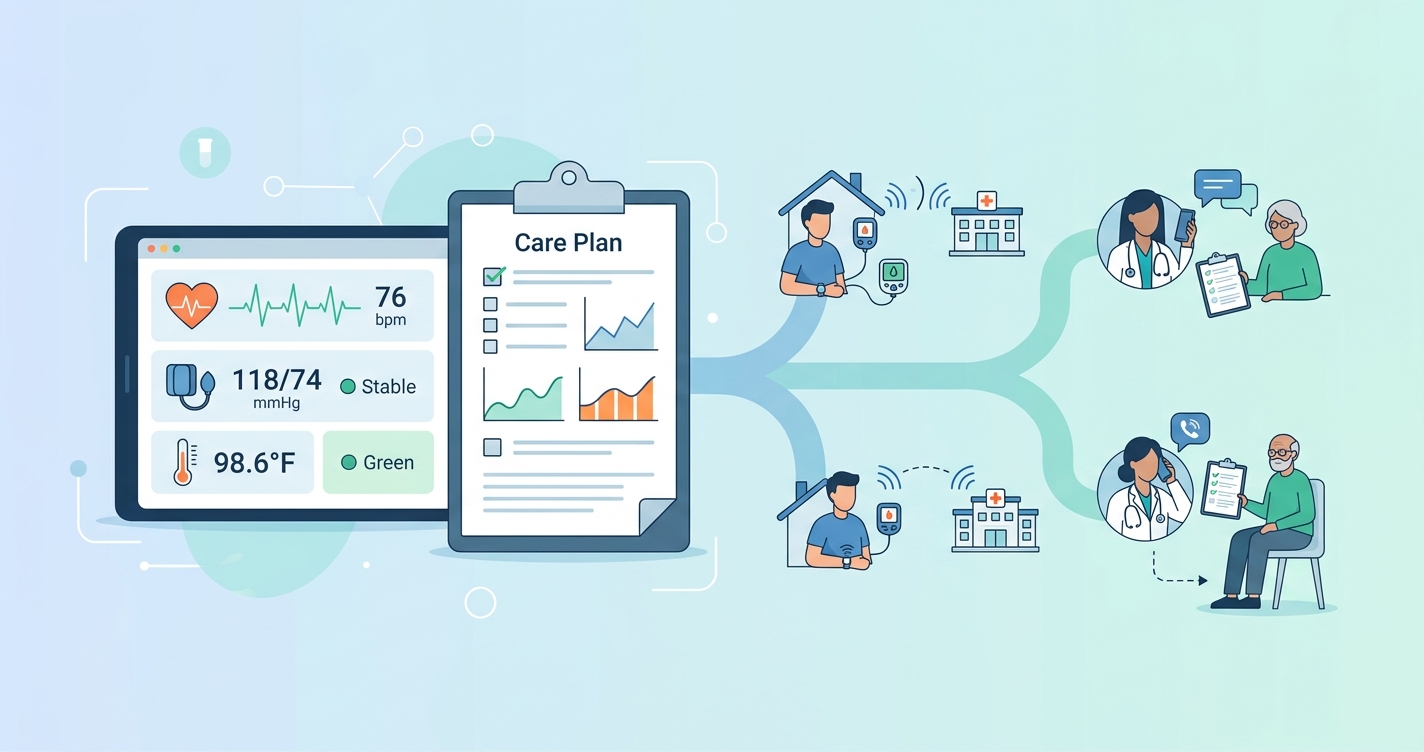
The rpm vs ccm chronic care reimbursement model question comes up whenever a care organization wants more recurring Medicare revenue without building a program patients will ignore. Both models support longitudinal care. Both can be billed monthly. Both reward work that happens between office visits. But they are built around different operating assumptions. RPM pays for physiologic monitoring tied to device data. CCM pays for care coordination, care planning, medication management, and patient support for people living with multiple chronic conditions.
"Remote patient monitoring use among traditional Medicare beneficiaries increased 555% from February 2020 to September 2021." — Mani Chhabra, David Lin, Andrew J. Moran, Michael L. Barnett, and Ateev Mehrotra, JAMA Network Open, 2022
RPM vs CCM chronic care reimbursement model: the core difference
The shortest way to think about the distinction is this: CCM is a care-management benefit, while RPM is a monitoring benefit.
CMS defines chronic care management for patients with two or more chronic conditions expected to last at least 12 months, or until death, and serious enough to create risk of death, acute exacerbation, or functional decline. The service depends on documented patient consent, a comprehensive electronic care plan, and non-face-to-face clinical work carried out across the month.
RPM is narrower and more data-driven. It is built around device supply, physiologic data collection, and treatment-management time linked to that data. In practical terms, the model works best when the program needs current readings and trend lines, not just outreach notes and task completion.
That difference matters because many chronic care operators do not actually need the same thing across their whole panel. Some patients need monthly medication review, referral coordination, and care-plan upkeep. Others need tighter surveillance because their blood pressure, pulse, oxygen saturation, weight, or respiratory status can drift before a nurse hears about symptoms.
| Question | CCM | RPM |
|---|---|---|
| Primary purpose | Care coordination for multiple chronic conditions | Physiologic monitoring using device data |
| Core Medicare logic | Pays for monthly management work | Pays for collection and management of physiologic data |
| Typical patient profile | Multi-condition patient needing ongoing coordination | Patient whose status changes are visible in measurable data |
| Operational center of gravity | Care plan, outreach, medication review, referrals | Device setup, data transmission, clinical review, escalation |
| Best fit for | Broad chronic care populations | Higher-risk subgroups needing tighter surveillance |
| Can be used together? | Yes, with separate documentation and non-overlapping time | Yes, with separate documentation and non-overlapping time |
When CCM is the better reimbursement model
CCM usually makes more sense when the organization is trying to build a wide, scalable chronic disease management program. CMS materials emphasize the comprehensive care plan, structured communication, and ongoing non-face-to-face support. That makes CCM attractive for ACOs, primary care groups, and chronic care vendors that manage patients with combinations of diabetes, hypertension, COPD, heart failure, depression, and medication complexity.
The strength of CCM is that it does not require every patient to generate device data. That is a big operational advantage. Many Medicare patients are clinically eligible for longitudinal support but are poor candidates for hardware-heavy workflows. Some have low digital confidence. Some already have device fatigue. Some are stable enough that monthly coordination matters more than daily readings.
CCM is usually the better first model when a program needs:
- Broader enrollment across a multi-condition population
- Care-plan documentation and revision
- Medication reconciliation and referral coordination
- Monthly outreach tied to risk stratification
- Support for patients who are unlikely to stay engaged with devices
Research on chronic disease management keeps pointing in that direction. In JAMA, J. Michael McWilliams and colleagues found that Medicare ACO savings grew over time as organizations built stronger population-management infrastructure. The takeaway is not that every care-coordination workflow produces savings on its own. It is that disciplined between-visit management has real economic value when it becomes operational routine rather than an occasional intervention.
When RPM is the better reimbursement model
RPM becomes more compelling when current physiologic status changes clinical decisions. That is common in heart failure, hypertension, COPD, post-discharge recovery, and other settings where deterioration often appears in vitals before it becomes a utilization event.
CMS guidance and industry billing summaries continue to center RPM on two practical thresholds: device-generated physiologic data and documented management time tied to that information. CMS has also maintained the well-known requirement that code 99454 generally depends on at least 16 days of data in a 30-day period. In other words, RPM is not just a check-in model. It is a monitoring workflow.
That sounds obvious, but it changes staffing, technology, and patient selection. The best RPM candidates are not simply the sickest patients. They are the patients for whom trend data can trigger meaningful action.
RPM is usually the better choice when a program needs:
- Ongoing physiologic trend visibility
- Faster detection of deterioration between visits
- Escalation rules tied to objective thresholds
- Targeted monitoring for higher-risk cohorts
- A reimbursement path connected to measurable monitoring activity
In a 2025 JMIR mHealth and uHealth systematic review, Geir Smedslund, Nina Østerås, and Christine Hillestad Hestevik at Diakonhjemmet Hospital in Oslo found that RPM may slightly reduce the proportion of hospitalizations and shorten length of stay for patients with noncommunicable diseases. That is not a magic-bullet finding, and the literature is still mixed across conditions, but it supports a practical conclusion: monitoring matters most when programs know exactly what decisions the incoming data should change.
Where RPM and CCM work together
For many organizations, the real answer is not RPM or CCM. It is segmentation.
CMS allows concurrent billing in the same month when the documentation is clean and the time for each service is distinct. That matters because the two models solve different problems. CCM gives the program a management backbone. RPM adds earlier physiologic visibility for the subset of patients most likely to benefit from closer surveillance.
A blended model often looks like this:
- CCM for the broader chronic population that needs structured monthly management
- RPM for patients with unstable disease, recent discharge, or clear need for tighter physiologic monitoring
- Shared nurse workflows, but separate time capture and billing logic
- Escalation from RPM alerts into CCM outreach, care-plan updates, and medication follow-up
That structure usually fits value-based care better than forcing every patient into a device-first program. It also matches what the Medicare population actually looks like: heterogeneous, clinically complex, and unevenly willing to adopt hardware.
Industry applications for chronic care organizations
ACOs and value-based care groups
ACOs usually need scale first. That makes CCM a natural operating layer across a broad panel. RPM is often reserved for subgroups where changing vitals can flag avoidable deterioration before emergency utilization follows.
Chronic care management vendors
Vendors focused on staffing and non-face-to-face care often start with CCM because it aligns with care-plan maintenance and recurring outreach. RPM becomes an add-on when clients want higher-acuity monitoring or stronger post-discharge workflows.
Disease-specific programs
Heart failure, COPD, and uncontrolled hypertension are better RPM candidates than lower-volatility conditions. Programs built around medication adherence, referral closure, and annual longitudinal support often lean harder on CCM.
Current research and evidence
The reimbursement debate is really an evidence-and-operations debate. CMS's Chronic Care Management Services fact sheet is explicit that CCM requires two or more chronic conditions, documented consent, and a comprehensive care plan. Those requirements tell you what CMS is buying: structured, longitudinal management.
On the RPM side, the best high-level utilization signal comes from the 2022 JAMA Network Open study by Mani Chhabra and colleagues. They reported a 555% increase in RPM use in traditional Medicare from February 2020 through September 2021. That rapid growth says two things at once. First, providers see a reimbursement opportunity. Second, programs still need discipline, because adoption can outpace evidence if organizations treat RPM as a billing tactic rather than a clinical workflow.
The 2025 meta-analysis on noncommunicable disease monitoring adds a more grounded view. RPM may reduce hospitalization rates modestly and shorten length of stay, but the benefit depends on patient selection and program design. Smart operators do not ask which code pays more in isolation. They ask which model fits the clinical job.
The future of chronic care reimbursement models
The next phase of the rpm vs ccm chronic care reimbursement model debate will probably be less about code awareness and more about workflow design. Medicare has already shown that it will pay for both coordination and monitoring. The harder question is how programs decide who belongs in which lane.
My read is that chronic care programs will keep moving toward layered models. Broad populations will stay under CCM-style management. Higher-risk segments will get tighter monitoring, increasingly with lower-friction tools that reduce device fatigue and improve consistency. That is where contactless daily check-ins become strategically interesting. They fit the clinical logic of longitudinal monitoring without assuming every patient wants another wearable or another piece of hardware on the kitchen table.
Solutions like Circadify are being built around that lower-friction end of the chronic care market. For teams exploring chronic care infrastructure, see Circadify's chronic care management solution overview.
You can also read related analysis on monthly CCM workflows with contactless vitals and how contactless vitals fit the CCM workflow.
Frequently asked questions
Can RPM and CCM be billed for the same patient in the same month?
Yes. CMS allows concurrent billing when the services are medically appropriate, the documentation is separate, and staff do not double-count the same time toward both services.
Is CCM broader than RPM?
Yes. CCM is usually the broader population-management model because it covers non-face-to-face care coordination for patients with multiple chronic conditions. RPM is more targeted because it depends on physiologic monitoring workflows.
Which patients are better candidates for RPM?
Patients are better RPM candidates when changing vitals or physiologic trends can drive intervention, such as people with heart failure, COPD, uncontrolled hypertension, or high post-discharge risk.
Which model is better for organizations trying to scale chronic care revenue?
Most organizations start with CCM for scale and add RPM for selected higher-risk groups. The right answer depends less on fee schedule comparisons and more on staffing model, patient mix, and whether incoming data will change clinical decisions.