Pulmonary Rehabilitation and Daily SpO2 Monitoring: How It Works
An analysis of how pulmonary rehab daily SpO2 monitoring works, where oxygen saturation trends matter, and how low-friction follow-up supports COPD care.
Pulmonary Rehabilitation and Daily SpO2 Monitoring: How It Works
Pulmonary rehab daily SpO2 monitoring sits at the intersection of exercise therapy, chronic disease follow-up, and practical risk management. Pulmonary rehabilitation has long been one of the most evidence-backed interventions in COPD care, but the monitoring question has changed. Programs are no longer just asking whether a patient can complete a supervised session safely. They are asking what happens between sessions, after discharge, and during the stretches of ordinary life when oxygen saturation, respiratory effort, and adherence can drift without anybody noticing right away.
"Pulmonary rehabilitation should be offered to adults with stable COPD because it improves dyspnea, exercise capacity, and health-related quality of life." — Carolyn L. Rochester, MD, ATS Clinical Practice Guideline, 2023
Why pulmonary rehab daily SpO2 monitoring matters in COPD care
Pulmonary rehabilitation is not just exercise class for people with lung disease. It is a structured program built around exercise training, symptom management, education, and long-term function. That matters because COPD decline often shows up in routines before it shows up in emergency care. A patient starts walking less. Recovery after exertion takes longer. Oxygen saturation drops more quickly with activity. Daily confidence falls even when the chart still looks stable.
The 2025 GOLD report still describes pulmonary rehabilitation as one of the most effective treatments for improving dyspnea, health status, and exercise tolerance in COPD across severity levels. That is the big picture. The smaller operational question is how clinicians keep a closer watch on patients while they are building exercise tolerance or trying to maintain gains at home.
SpO2 is part of that answer because oxygen saturation gives teams a simple, familiar signal. It does not replace full clinical assessment, and it does not explain every cause of shortness of breath. But it helps programs see whether activity is staying within a tolerable range, whether exercise-related desaturation is becoming more common, and whether a patient who looked fine last week now needs a call.
| Monitoring question in pulmonary rehab | Traditional session-only approach | Daily or near-daily SpO2 monitoring approach |
|---|---|---|
| When is desaturation noticed? | During supervised visits only | During rehab sessions and between-session check-ins |
| What gets captured? | Snapshot readings | Trend lines, recovery patterns, missed check-ins |
| Best use case | Safety during scheduled exercise | Safety plus longitudinal follow-up |
| What can clinicians spot earlier? | Obvious exertional drops in clinic | Gradual change in tolerance or home status |
| Burden on patients | Travel plus in-person measurement | Lower if check-ins fit into existing routines |
| Main value | Supervised exercise oversight | Earlier outreach and better continuity |
How SpO2 monitoring is used during pulmonary rehabilitation
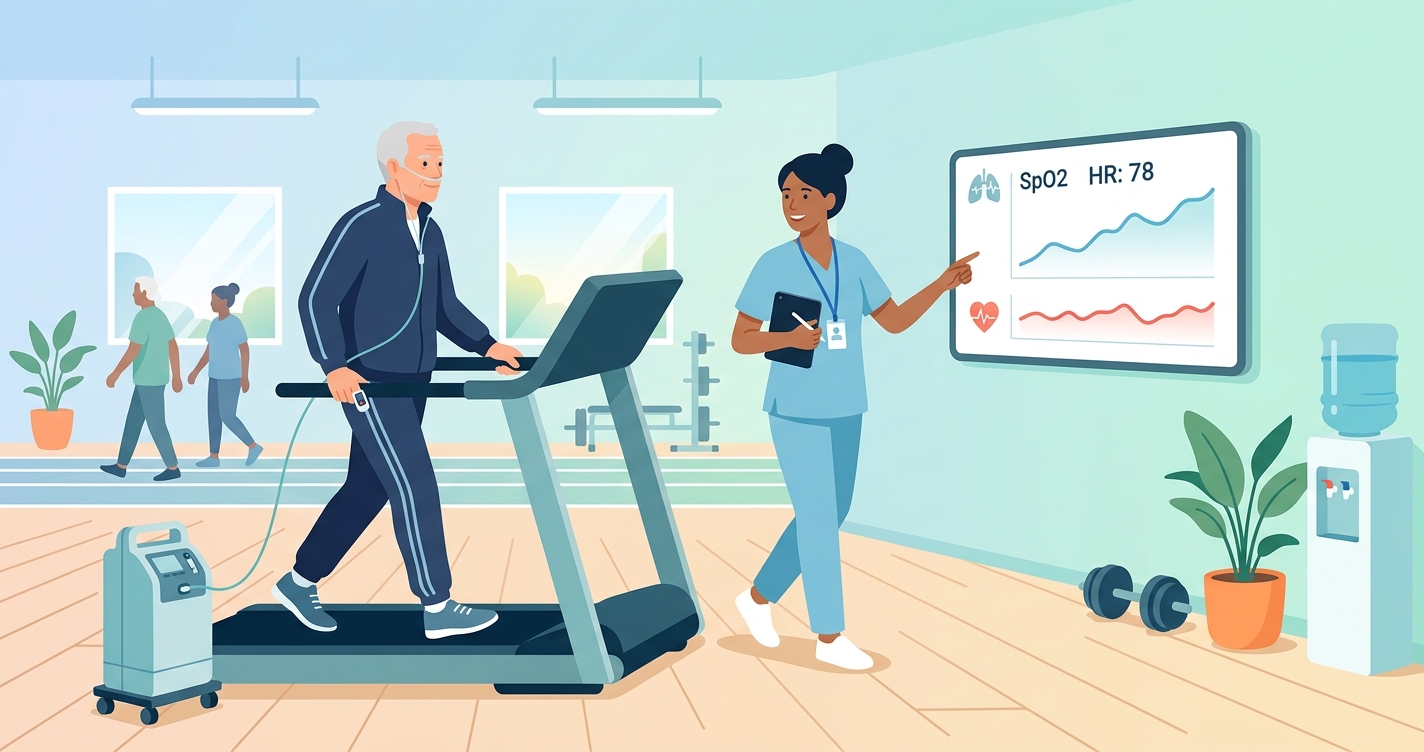
In standard pulmonary rehab, oxygen saturation is often checked before exercise, during exertion, and in recovery. That helps therapists decide whether the training load is appropriate and whether a patient needs rest, closer observation, or oxygen adjustment according to the program's clinical protocols.
The reason this matters is straightforward: exercise-induced desaturation is common in COPD. Agent-search results from ERS and ATS-linked sources note that many pulmonary rehab patients desaturate with activity, and programs generally aim to keep saturation above the high-80s to low-90s range depending on the patient's condition and oxygen prescription.
That is also why the 6-minute walk test keeps showing up in pulmonary rehab research. It is not only a function test. It is a way to observe how a patient's lungs and cardiovascular system respond to exertion in real time.
A 2022 study by Bruno Berton and colleagues found that continuous pulse oximetry during the 6-minute walk test improved prediction of mortality and hospitalization in COPD compared with relying on end-test saturation alone. In their cohort of 421 patients, 19.2% had clinically relevant desaturation that would have been missed if staff looked only at the SpO2 reading at the end of the walk. That is an important detail. The lowest saturation does not always happen at the finish line.
What daily SpO2 monitoring adds between rehab sessions
Pulmonary rehab programs do not usually fail because the exercise science is weak. They fail because continuity is hard. Patients miss visits, transportation falls through, symptoms vary day to day, and home monitoring becomes one more chore in a life already crowded with inhalers, medications, appointments, and fatigue.
Daily SpO2 monitoring adds value when it is used to answer practical questions such as:
- Is the patient recovering from exertion about as expected?
- Are saturation dips happening more often during normal daily activity?
- Is a recent exacerbation still settling down, or is the patient drifting the wrong direction?
- Is the patient engaging consistently enough to make rehab progress sustainable?
- Does the care team need to adjust follow-up intensity before the next scheduled session?
For COPD populations, trend data matters more than isolated numbers. A single reading can be noisy. Several days of lower resting saturation, slower recovery after activity, or missed check-ins paired with worsening symptoms tell a more useful story.
That is one reason home-based and tele-rehabilitation models have gained attention. ATS materials on telerehabilitation and a randomized multicenter trial of supervised pulmonary tele-rehabilitation in severe COPD both point toward the same operational reality: remote follow-up can extend the reach of pulmonary rehab when programs need a way to support patients outside the clinic.
Where pulmonary rehab daily SpO2 monitoring fits best
Some pulmonary rehab populations benefit more than others from closer oxygen saturation follow-up.
COPD patients with exertional desaturation
These are the clearest candidates. If oxygen saturation falls during exertion, teams need a better sense of how often that is happening, how severe it is, and whether tolerance is changing over time.
Recent hospital discharges
The period after an exacerbation is messy. Symptoms can improve slowly, confidence may be low, and readmission risk is still on the table. Daily monitoring helps programs decide who needs extra outreach.
Patients transitioning to home-based rehab
Home-based rehab works best when there is still some visible clinical signal. SpO2 check-ins help replace at least part of the oversight lost when the patient is no longer in the gym or clinic.
Patients with low tolerance for device-heavy workflows
This is where monitoring design starts to matter. A conventional pulse oximeter is useful, but adherence drops when patients have to remember too many separate tasks. Lower-friction approaches can broaden participation in chronic care populations that are already managing a lot.
Readers looking at adjacent chronic-care use cases may also want to see our analysis of how cardiology practices use remote vitals monitoring and how contactless monitoring supports heart failure patients at home.
Current research and evidence
The evidence base around pulmonary rehab is stronger than many digital health categories, which is part of why daily monitoring deserves serious attention.
- Carolyn L. Rochester and colleagues wrote the 2023 ATS Clinical Practice Guideline recommending pulmonary rehabilitation for adults with stable COPD and highlighting benefits in dyspnea, exercise capacity, and quality of life.
- The 2025 GOLD report again characterized pulmonary rehabilitation as one of the most effective nonpharmacologic treatments in COPD and recommended pulse oximetry when clinicians need to assess oxygenation and possible oxygen needs.
- Bruno Berton and colleagues reported in 2022 that continuous pulse oximetry during the 6-minute walk test improved prediction of all-cause mortality and hospitalization in COPD. Their study found that 19.2% of patients had desaturation missed by end-test measurement alone.
- Research presented through ERS and ATS channels has also supported home-based and tele-rehabilitation models, especially when programs need to extend access and preserve monitoring outside facility-based sessions.
- A pilot study on remote pulse oximetry in pulmonary rehabilitation found that remote monitoring was feasible and valid enough to support rehab use cases, which matters for programs trying to move parts of follow-up into the home.
The point is not that every COPD patient needs the same daily protocol. The point is that pulmonary rehab works best when staff can see enough physiologic signal to respond before setbacks become exacerbations.
What clinicians usually look for in daily monitoring workflows
Strong pulmonary rehab monitoring programs tend to focus on a short list of signals instead of drowning staff in data.
- Resting SpO2 relative to the patient's usual baseline
- SpO2 response to light activity or prescribed exercise
- Recovery time after exertion
- Resting and post-exertion heart rate trends
- Symptom changes, especially dyspnea and fatigue
- Missed check-ins, which often tell their own story
This is where daily SpO2 monitoring stops being a gadget discussion and becomes a workflow discussion. Data only matters if somebody owns the next step. That might be a therapist, nurse, respiratory clinician, or chronic care coordinator deciding whether to reassure the patient, adjust intensity, or escalate for medical review.
The future of pulmonary rehab daily SpO2 monitoring
The next stage probably looks less like more hardware and more like better continuity. Pulmonary rehab programs already know how to supervise exercise safely. What they need is a cleaner bridge between structured sessions and everyday life.
More baseline-aware monitoring
Programs are moving away from blunt one-number thresholds and toward trend interpretation. A change from a patient's norm often matters more than one isolated reading.
More rehab delivered outside the facility
Home-based and hybrid rehab models are likely to keep growing because access remains a major bottleneck. Monitoring has to travel with that shift.
Lower-friction chronic care follow-up
For many COPD patients, the real barrier is not willingness. It is fatigue. Any model that reduces device burden has a better shot at sustained participation over weeks and months.
Frequently asked questions
Why is SpO2 monitored during pulmonary rehabilitation?
Because oxygen saturation helps clinicians see how safely a patient tolerates exercise. It can reveal exertional desaturation, guide pacing, and support decisions about closer follow-up or oxygen assessment.
What does daily SpO2 monitoring add after rehab sessions?
It adds trend visibility between visits. That helps teams spot worsening tolerance, slower recovery, or signs that a patient may need outreach before the next supervised session.
Is one SpO2 reading enough to judge progress in pulmonary rehab?
Usually not. COPD management works better with patterns than snapshots. Baseline change, exertional response, symptom shifts, and recovery trends give a more useful picture than a single reading alone.
Where do contactless monitoring tools fit in pulmonary rehab follow-up?
They fit where programs want lower-friction daily check-ins for chronic care populations that may not stay engaged with more device-heavy routines. The goal is not to replace every clinical tool. It is to make ongoing monitoring easier to sustain.
Pulmonary rehabilitation works because it gives COPD patients structured support at exactly the point where deconditioning, breathlessness, and fear start feeding each other. Daily SpO2 monitoring extends that support beyond the supervised session. It helps programs see trend change sooner, keep a closer eye on higher-risk patients, and make home-based follow-up more practical. Solutions like Circadify's chronic care management approach are being built around that same need: more consistent physiologic check-ins, less device fatigue, and a workflow that fits long-term chronic care.