Medication Adherence and Vital Sign Patterns: What to Look For
An analysis of medication adherence vital sign patterns in chronic care, including how blood pressure, heart rate, and engagement trends can signal change.
Medication Adherence and Vital Sign Patterns: What to Look For
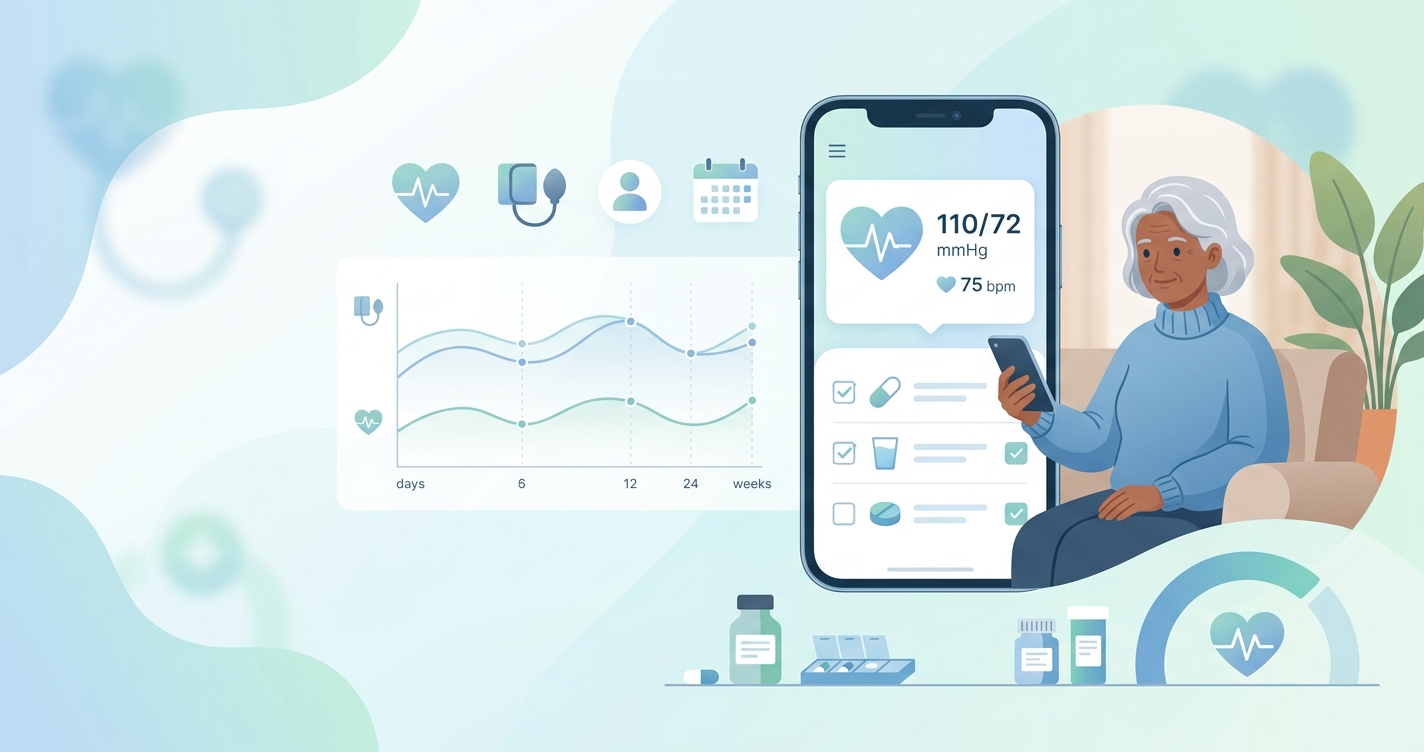
Medication adherence vital sign patterns matter because missed doses rarely announce themselves in a clean, obvious way. In chronic care, nonadherence usually shows up as drift: blood pressure starts running higher than usual, resting heart rate creeps up, daily check-ins become less consistent, and a patient who looked stable two weeks ago begins to look a little less predictable. For care management teams, that quiet change is often the real operational problem.
"In developed countries, adherence among patients suffering chronic diseases averages only 50 percent." — World Health Organization, Adherence to Long-Term Therapies: Evidence for Action, 2003
Medication adherence vital sign patterns are usually about trend change, not one bad reading
Medication adherence is often discussed as a behavioral issue, but for chronic care programs it is also a signal-detection issue. Care teams are trying to answer a practical question: when a patient stops taking medication as prescribed, what changes first?
The answer depends on the condition and the drug class, but the pattern is often familiar. Antihypertensive nonadherence can show up through rising home blood pressure. Heart failure medication lapses may appear as higher resting heart rate, respiratory strain, weight-related symptom reports, or a broader loss of physiologic stability. Diabetes medications may affect glucose control first, but they can also change energy, heart rate, and the overall rhythm of daily check-ins.
A 2022 systematic review on medication adherence and blood pressure control found that poor adherence to antihypertensive therapy was associated with higher blood pressure and worse cardiovascular outcomes, while good adherence was linked to meaningful systolic and diastolic blood pressure reductions. That matters in chronic care because elevated pressure is not just a number on a dashboard. It can be an early sign that the regimen in real life no longer matches the regimen in the chart.
| Pattern in daily monitoring | What it may suggest | Why care teams watch it closely |
|---|---|---|
| Blood pressure rising over several days | Missed antihypertensive doses, undertreatment, or treatment changes | Persistent elevation raises stroke, heart failure, and admission risk |
| Resting heart rate rising above baseline | Physiologic stress, medication lapse, worsening symptoms, or poor sleep | Rate changes often appear before the patient requests help |
| Respiratory rate trending upward | Heart failure or COPD instability, fluid burden, infection, or poor adherence | Respiratory change is often an early deterioration marker |
| Greater day-to-day volatility | Irregular dosing, inconsistent routines, or unstable disease control | Instability can be as informative as the average value |
| Missed check-ins after a period of consistency | Engagement drop, medication fatigue, cognitive issues, or symptom burden | A missing signal can be a signal |
| Stable numbers with steady participation | Better adherence or at least a more reliable routine | Consistency makes escalation decisions easier |
The important point is that no single vital sign proves medication nonadherence. What helps is the combination of physiologic drift and behavior change over time.
What care teams actually look for in chronic care populations
Most chronic care organizations do not expect a dashboard to tell them, with certainty, that a patient skipped three doses. That is not how the work goes. Instead, teams look for a cluster of small clues that make outreach worth the time.
Common watch points include:
- Blood pressure moving away from a patient's normal range after a period of control
- Resting heart rate staying elevated for several days
- Respiratory rate increasing alongside lower activity or symptom complaints
- Irregular timing of check-ins from a patient who was previously routine
- More gaps in monitoring after a medication adjustment or hospital discharge
- Worsening self-reported fatigue, dizziness, edema, or breathlessness paired with vital sign drift
This is one reason medication adherence cannot be separated from patient engagement. The Electronic Framingham Heart Study, led by Tenes J. Paul, Katherine Sadaniantz, Apurv Soni, and David D. McManus, identified three home blood pressure monitoring trajectories: early discontinuation, gradual decrease, and high adherence. That work focused on monitoring adherence rather than pills, but the lesson is useful for chronic care teams anyway. People tend to reveal their routine through patterns. Once the routine breaks, the physiology often gets harder to interpret.
Why heart failure and hypertension programs pay so much attention to adherence patterns
Heart failure programs have unusually little margin for error. A patient can look mostly fine until they do not. In a widely cited study on medication nonadherence in heart failure, nonadherence was associated with a hazard ratio of 2.07 for the combined outcome of all-cause mortality plus cardiovascular hospitalization. Other analyses in the same body of literature found that each 10 percent increase in adherence was associated with fewer hospital admissions and lower mortality.
That is why adherence surveillance in heart failure is rarely about policing patients. It is about catching instability while there is still time to intervene. A modest but steady rise in resting heart rate, a change in breathing pattern, or a drop in daily participation may be enough to justify a nurse call.
Hypertension programs see a slightly different pattern. Blood pressure is often the clearest signal, but not always the cleanest one. Patients miss doses for many reasons: cost, side effects, confusion after a regimen change, feeling "fine," or simply losing the habit. The American Heart Association has repeatedly stressed that adherence is one of the biggest reasons blood pressure control fails in routine care. When daily or near-daily data is available, the issue becomes easier to spot.
The evidence behind remote monitoring and medication adherence
The broader remote monitoring literature points in the same direction. Donato Giuseppe Leo, Benjamin J.R. Buckley, Mahin Chowdhury, and colleagues reported in a 2022 JMIR systematic review and meta-analysis of 96 studies that interactive remote patient monitoring was associated with lower mortality, improved blood pressure, and lower glycated hemoglobin in chronic disease populations. The pooled mortality risk ratio was 0.71, and mean systolic blood pressure improved by 3.85 mm Hg.
Those numbers do not mean monitoring solves adherence by itself. They do suggest that more frequent signal gives clinical teams a better chance to notice when treatment is no longer holding.
The World Health Organization made the underlying problem plain years earlier. Its 2003 adherence report argued that poor adherence to long-term therapy leads to more frequent and longer hospitalizations and wastes healthcare resources on a massive scale. Two decades later, chronic care teams are still dealing with the same problem. The difference is that remote monitoring makes the drift more visible.
Where contactless monitoring fits in medication adherence surveillance
Not every patient wants another device, and plenty of chronic care populations are already carrying too much equipment. That is one reason contactless monitoring is getting attention. If a patient can complete a short camera-based check-in from a phone or tablet, a care program may get more frequent participation with less device fatigue.
For medication adherence work, that matters because care managers usually need trend coverage across a broad panel, not just perfect data from a few highly engaged patients. A low-friction monitoring model can help surface:
- baseline shifts after a medication change
- emerging instability between office visits
- engagement drop-off that may travel with nonadherence
- patients who need outreach before symptoms become acute
Readers looking at adjacent chronic care questions may also want to see our analysis of how CCM programs use contactless vitals for monthly check-ins and how value-based care organizations use daily vitals data.
Industry applications
Chronic care management vendors
CCM operators use trend data to decide which patients deserve a call today, not next week. Medication adherence patterns help them separate a routine fluctuation from the start of a problem.
Value-based care organizations and ACOs
Risk-bearing groups care about adherence because they pay for the downstream consequences. The useful question is usually not "did the patient take the medication?" but "does this patient look less stable than last week?"
Post-discharge heart failure programs
These teams often watch for the first signs that the discharge plan is breaking down. In practice, that may mean rising heart rate, respiratory drift, or falling engagement before a readmission happens.
Current research and evidence
Several findings keep showing up across the literature:
- The World Health Organization reported in 2003 that average adherence for chronic disease therapy in developed countries was about 50 percent, and that poor adherence leads to more frequent and longer hospitalizations.
- The 2022 systematic review on medication adherence and blood pressure control found that poor adherence was tied to higher blood pressure and higher cardiovascular risk, while stronger adherence was associated with lower event rates.
- Research on heart failure medication nonadherence found a hazard ratio of 2.07 for all-cause mortality plus cardiovascular hospitalization among nonadherent patients.
- Tenes J. Paul, Katherine Sadaniantz, Apurv Soni, David D. McManus, and colleagues found that home monitoring behavior tends to fall into recognizable trajectories, including early discontinuation and gradual decline.
- Donato Giuseppe Leo and colleagues found in 2022 that interactive remote patient monitoring reduced mortality and improved blood pressure and HbA1c outcomes across chronic disease studies.
The through-line is simple: adherence problems often show up as pattern problems first.
The future of medication adherence vital sign patterns
The next stage of chronic care monitoring will probably be more baseline-aware and less device-centered. Programs are getting better at asking whether a patient has changed relative to their own norm, not just whether one reading crossed a threshold. That is a better fit for medication adherence work, where the earliest signal is often subtle.
I keep coming back to this point: the hard part is not proving, in a forensic sense, that a dose was missed. The hard part is recognizing when a patient is sliding off course and making contact while the slide is still small. If monitoring tools can lower the work required from patients, chronic care teams have a better shot at doing that well.
Frequently asked questions
Can vital signs prove medication nonadherence?
No. Vital signs can suggest nonadherence, especially when blood pressure, heart rate, respiratory rate, and check-in behavior all drift together, but they do not prove why the change happened.
Which vital sign patterns are most useful for spotting adherence problems?
Blood pressure trend, resting heart rate, respiratory rate, day-to-day variability, and missed check-ins are often the most useful signals. The value usually comes from the pattern over time, not one isolated reading.
Why does medication adherence matter so much in chronic care?
Because chronic care programs are trying to prevent instability, hospitalization, and avoidable escalation between visits. Poor adherence undermines all three.
How can contactless monitoring help with medication adherence surveillance?
It can reduce patient burden by making daily or near-daily check-ins easier. Better participation gives care teams more trend data, which makes it easier to notice early drift.
Medication adherence problems usually arrive quietly. They look like rising pressure, a slightly faster pulse, more gaps in routine, or a patient who has become harder to see between visits. Solutions like Circadify's chronic care management approach are being built around that reality: give care teams a lower-friction way to capture more frequent signal so they can respond before a small change turns into a bigger one.