Daily Contactless Monitoring for Hypertension: A Practical Guide
Daily contactless monitoring hypertension analysis for CCM teams, covering workflow design, evidence, and where camera-based check-ins fit.
Daily Contactless Monitoring for Hypertension: A Practical Guide
Daily contactless monitoring hypertension programs are getting serious attention because hypertension is not really a clinic-only condition. Blood pressure rises and falls at home, during medication changes, after hospital discharge, and during long stretches when no clinician is watching. That is why chronic care teams, ACOs, and virtual hypertension programs increasingly want daily signal instead of occasional snapshots. The practical question is not whether more data sounds useful. It is whether patients will actually complete a daily workflow often enough to make that data matter.
"Remote patient monitoring is associated with improved hypertension control, with systolic blood pressure improving by 7.3 mm Hg overall and 16.7 mm Hg among stage 2 hypertension patients." — 2024 cohort analysis of hypertension RPM outcomes
Why daily contactless monitoring matters for hypertension
Hypertension management has always had a visibility problem. Office readings are affected by timing, stress, adherence, and white-coat effects. Even home cuff programs can lose momentum because the workflow asks patients to find the cuff, place it correctly, sit still, repeat measurements, and remember to transmit or report them.
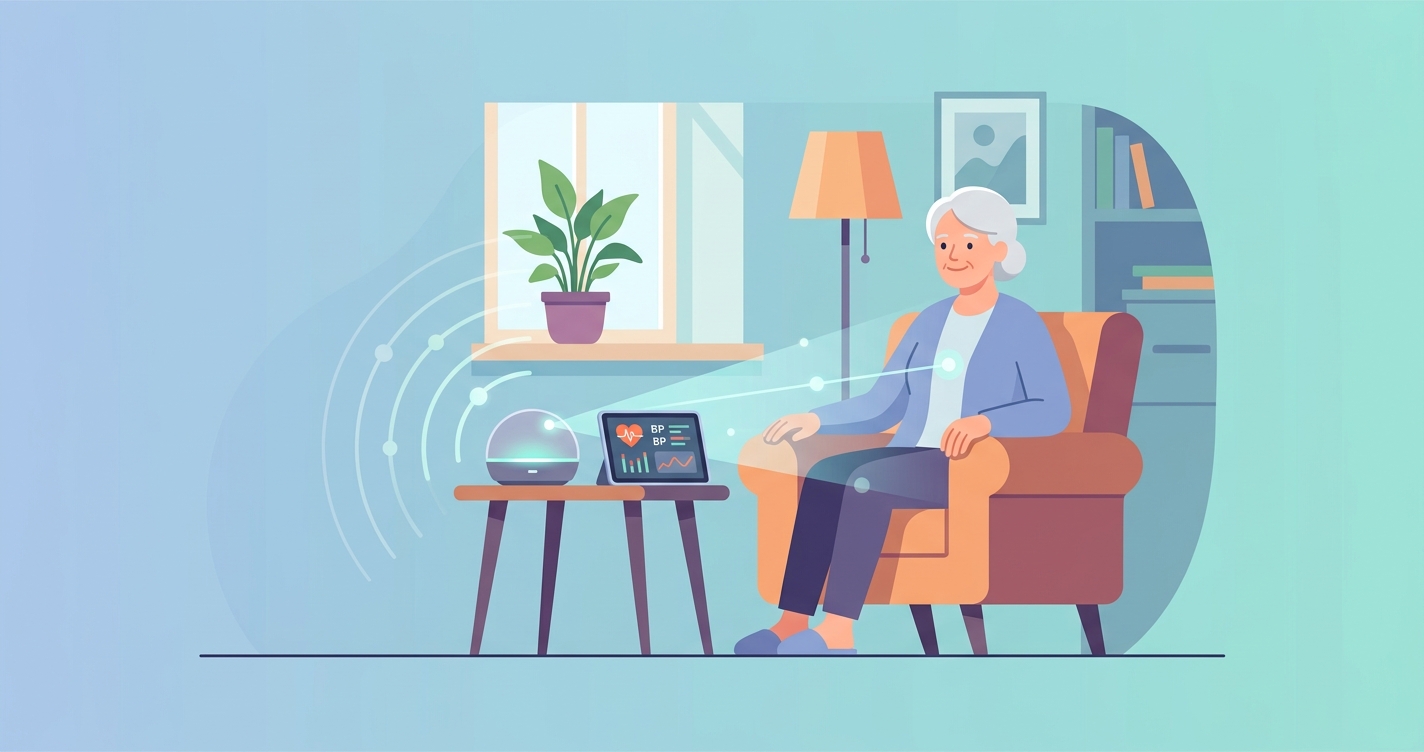
That is why daily contactless monitoring is interesting. A camera-based check-in does not replace every conventional blood pressure workflow, but it can create a lower-friction way to maintain daily engagement and watch physiologic trends between visits. For chronic care organizations, that may be the bigger advantage. A simpler routine often produces more consistent participation than a better instrument that patients stop using after two weeks.
Melissa Kapoor and colleagues reported in JMIR Cardio in 2024 that the Lifelight app, a contactless and calibration-free blood pressure and pulse rate monitor, showed promising screening performance in normotensive and stage 1 hypertensive adults. The result does not mean camera-based tools have replaced cuffs for diagnosis. It does suggest that contactless measurement is moving from abstract concept toward practical monitoring use cases.
| Daily hypertension monitoring model | Traditional visit-based model | Home cuff RPM model | Contactless daily check-in model |
|---|---|---|---|
| Data frequency | Infrequent | Usually periodic | Can be near-daily |
| Patient effort | Travel and appointment time | Device setup and repeat measurements | Short phone or tablet scan |
| Best operational use | Diagnosis and medication review | Confirmed home BP management | Daily engagement and trend visibility |
| Common failure point | Too little signal between visits | Device fatigue and nonadherence | Real-world accuracy variability |
| Best fit buyer | Primary care and specialty clinics | RPM programs | CCM teams, ACOs, and low-friction chronic care workflows |
The basic appeal is practical: daily monitoring only helps if the patient keeps showing up.
What a practical hypertension monitoring workflow actually looks like
Despite the title, the best practical guide is not a tutorial for consumers. It is an operating model for care teams.
Most workable hypertension programs rely on four layers:
- an initial diagnosis or medication management plan
- home monitoring between visits
- staff review of adherence and trend change
- escalation when the patient moves off baseline
Contactless monitoring fits that structure when the goal is to add repeatable signal, especially in populations that struggle with device-heavy programs.
Between-visit visibility matters more than one isolated reading
Hypertension usually worsens quietly. Medication side effects, inconsistent adherence, poor sleep, stress, fluid retention, and cardiometabolic comorbidity often show up between scheduled visits. If the only measurement happens during clinic appointments, teams are making decisions with incomplete context.
A 2024 Healthcare cohort analysis found that remote patient monitoring was associated with better hypertension outcomes, including lower rates of uncontrolled hypertension and stage 2 hypertension. The study drew patients from Prisma Health Upstate and HealthSnap workflows, and its main lesson was straightforward: more frequent monitoring, paired with care response, improves control.
Lower-friction capture can broaden participation
That sounds obvious, but it matters. Karen C. Tran, Meagan Mak, Laura M. Kuyper, and Kendall Ho reported in a 2024 JMIR Formative Research pilot study that home blood pressure telemonitoring after emergency department discharge was feasible, with high patient satisfaction and meaningful rates of blood pressure control at three months. Their work at the University of British Columbia and Vancouver Coastal Health Research Institute focused on cuff-based telemonitoring, but the operational point carries over: patients participate when the program feels manageable.
Contactless workflows are attractive for the same reason. They reduce setup burden and can fit into a daily chronic-care check-in more naturally than a hardware-dependent routine.
Where daily contactless monitoring helps hypertension programs most
Not every hypertension population needs the same model. The highest-value use cases tend to look like this:
Chronic care management populations
CCM teams often need a lightweight monthly or daily touchpoint for patients with hypertension plus diabetes, COPD, heart failure, or renal disease. A camera-based check-in can support ongoing engagement without asking every patient to manage another piece of equipment.
Post-discharge and medication-adjustment periods
The days after discharge or medication titration are when teams most need fresh signal. A brief daily scan is useful here because it can reveal whether the patient is staying engaged and whether follow-up should happen sooner.
Hard-to-control hypertension programs
The American Heart Association reported in 2024 that a remote monitoring program with pharmacist support helped adults with treatment-resistant hypertension, with up to 74% of participants reaching blood pressure below 140/90 mm Hg within one year. That study involved 205 adults and was led by researchers from the University of Illinois Chicago College of Pharmacy. The lesson is not that every program needs a pharmacist. It is that monitoring works best when somebody owns the next step.
Patients with device fatigue
This may be the simplest use case of all. Some patients are willing to use a cuff every day. Others are not. A contactless model is valuable when it reaches people who would otherwise contribute no between-visit data at all.
Readers exploring adjacent chronic-care use cases may also want our analysis of how value-based care organizations use daily vitals data and how CCM programs use contactless vitals for monthly check-ins.
Current research and evidence
The evidence base around daily contactless monitoring for hypertension sits at the intersection of two literatures: established remote blood pressure monitoring and newer camera-based measurement research.
A few findings matter most.
- Melissa Kapoor, Blair Holman, and Carolyn Cohen reported in JMIR Cardio in 2024 that a contactless smartphone and tablet app showed promising screening performance for hypertension monitoring in normotensive and stage 1 hypertensive adults.
- A 2024 retrospective cohort analysis in Healthcare found that RPM was associated with improved hypertension control, including a 7.3 mm Hg improvement in systolic blood pressure overall and a 16.7 mm Hg improvement among stage 2 hypertension patients.
- Karen C. Tran and colleagues at UBC and Vancouver Coastal Health Research Institute found in JMIR Formative Research that home blood pressure telemonitoring after ED discharge was feasible, with 71.4% of participants reaching home systolic control and 85.7% reaching diastolic control at three months.
- University of Chicago investigators reported in a mixed-methods study of 1,744 participants that RPM improved blood pressure care, with stronger results among patients who stayed more engaged with the program.
- AHA coverage of research from the University of Illinois Chicago showed that remote monitoring combined with pharmacist-led follow-up improved control in hard-to-manage hypertension, reinforcing the importance of response workflows rather than passive dashboards.
What these studies share is more important than their methodological differences. Monitoring succeeds when teams get repeatable patient signal and act on it.
What buyers should evaluate before adopting daily contactless monitoring
For chronic care buyers, the hard question is not whether contactless monitoring is interesting. It is whether it fits operations.
A few evaluation points matter:
- Is the program using contactless scans for screening, engagement, trend tracking, or diagnosis support?
- How often will staff review trend change rather than isolated readings?
- Which patients still need cuff-based confirmation or escalation?
- Does the workflow feed CCM, RPM, or value-based care outreach instead of creating another disconnected dashboard?
- Will patients actually complete the daily check-in for more than a few days?
That last question is the one I keep coming back to. In hypertension care, elegant monitoring theory is easy. Repeated patient participation is hard.
The future of daily contactless monitoring for hypertension
The next phase of hypertension monitoring will probably be hybrid.
Daily engagement will matter as much as device sophistication
Programs are starting to realize that a lower-burden daily habit can outperform a more exact workflow that patients abandon.
Contactless tools will support, not erase, cuff-based workflows
Diagnosis, confirmation, and medication decisions will still lean on validated blood pressure pathways. But contactless check-ins may supply the between-visit layer those workflows have always lacked.
Hypertension programs will become more baseline-aware
The most useful programs will watch for change over time: worsening adherence, rising physiologic stress, missed check-ins, and sustained drift from a patient’s norm.
Frequently Asked Questions
What is daily contactless monitoring for hypertension?
It is a monitoring approach that uses a phone, tablet, or camera-enabled device to capture brief daily physiologic readings or screening signals related to hypertension management without requiring a wearable.
Can contactless monitoring replace home blood pressure cuffs?
Not completely. Cuff-based monitoring remains central for diagnosis and treatment decisions. Contactless tools are more useful today as a lower-friction layer for screening, engagement, and between-visit trend monitoring.
Why is daily monitoring useful for hypertension?
Hypertension changes between clinic visits, especially after medication adjustments or hospital discharge. Daily monitoring helps care teams see who is stable, who is disengaging, and who may need faster outreach.
Which organizations benefit most from daily contactless monitoring?
Chronic care management companies, ACOs, value-based care organizations, and virtual hypertension programs benefit most when they need frequent patient signal but struggle with device adherence.
For hypertension programs, the real promise of contactless monitoring is not that it replaces every existing tool. It is that it may make daily participation easier. And in chronic care, easier is often what keeps the workflow alive. Solutions like Circadify’s chronic care management platform are being built around that low-friction model, giving care teams a practical way to collect more between-visit signal without adding more device fatigue.