
What Are the Cost Savings of Contactless Chronic Care Monitoring?
A research-based look at cost savings contactless chronic monitoring can create through lower device burden, fewer hospitalizations, and better chronic care workflow efficiency.
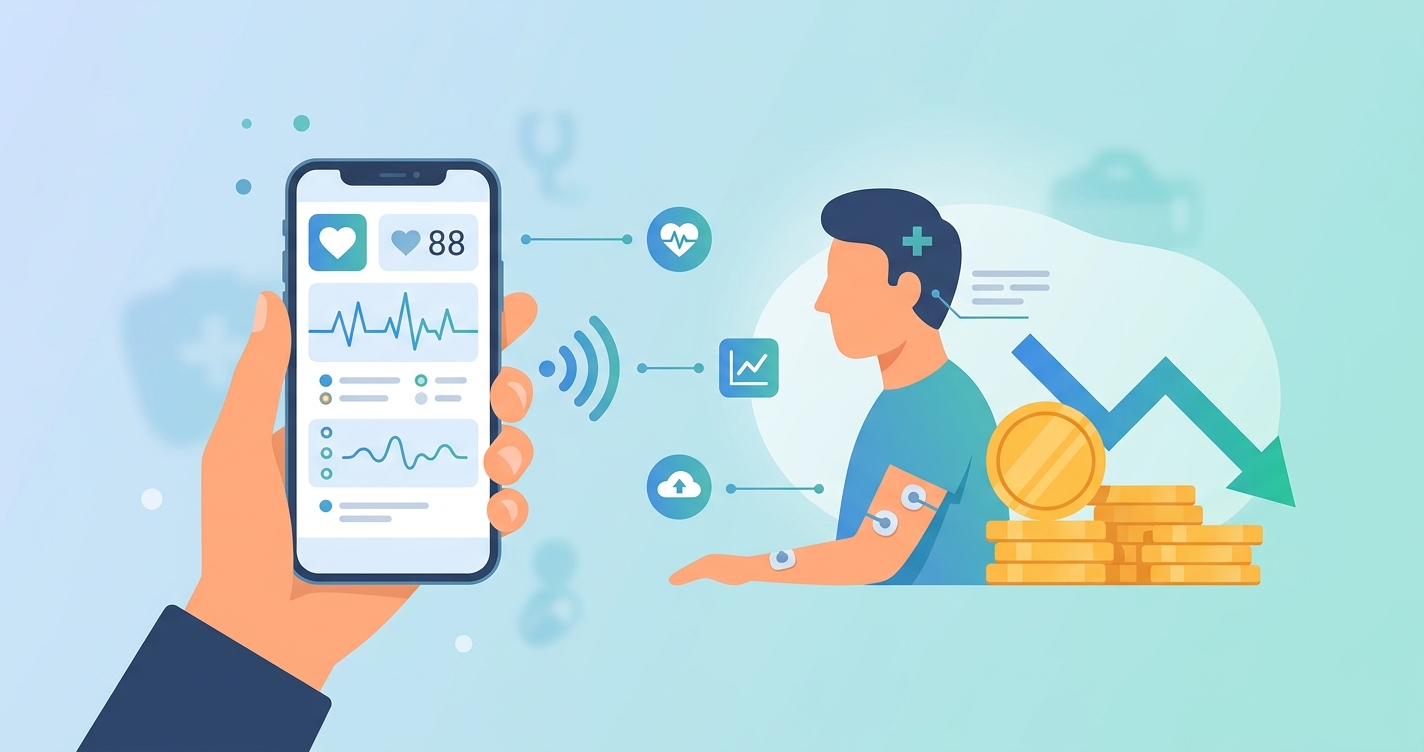
What Are the Cost Savings of Contactless Chronic Care Monitoring?
Cost savings contactless chronic monitoring has become a serious operating question for chronic care leaders, not a speculative one. Programs built around heart failure, COPD, diabetes, and multimorbidity already know the math on avoidable utilization: one missed deterioration can wipe out months of care-management margin. The harder question is whether monitoring can stay cheap enough, and simple enough, to scale across a broad Medicare or value-based care population. Contactless monitoring matters because it tries to lower costs on both sides of the ledger at once: fewer devices to ship and support, and better odds of catching clinical drift before it becomes an ED visit or admission.
"People with multiple chronic conditions account for 71% of all health care spending and 93% of Medicare spending." — Agency for Healthcare Research and Quality, Multiple Chronic Conditions Chartbook
Why cost savings contactless chronic monitoring is getting attention
Traditional remote monitoring can absolutely help chronic disease programs, but it also comes with stubborn operational costs. Somebody has to source devices, ship them, replace them, train patients, troubleshoot syncing issues, and chase adherence when the blood pressure cuff ends up in a closet. For narrow high-risk cohorts, that may still be worth it. For larger chronic care panels, the economics get messy fast.
Contactless monitoring changes the model because it uses the screen a patient already has: usually a phone or tablet, sometimes a kiosk or shared device. That does not mean the program becomes free. Staff time, software, onboarding, and escalation still matter. But it can remove the hardware burden that often eats the first layer of ROI.
The savings case usually comes from four places:
- lower device procurement and replacement costs
- lower support burden for setup, charging, and connectivity problems
- better patient participation because the workflow feels lighter
- earlier outreach that reduces hospitalization risk and post-acute cost
| Cost area | Device-heavy chronic monitoring | Contactless chronic monitoring |
|---|---|---|
| Upfront hardware | Cuffs, wearables, pulse oximeters, scales | Often uses existing patient phone or tablet |
| Logistics | Shipping, inventory, returns, replacement | Minimal hardware logistics |
| Tech support | Pairing, charging, syncing, firmware issues | More focused on basic scan usability |
| Patient adherence risk | Higher when several devices are involved | Lower when the check-in is brief and familiar |
| Clinical visibility | Can be rich but often limited to adherent users | Broader coverage when more patients actually check in |
| Main savings lever | Better data for a narrower cohort | Lower operating friction across a wider population |
That last line is where most buyers pause. The best savings story is not always the most data-rich program. Often it is the program patients keep using in month three, month six, and month nine.
Where the financial case becomes real
Contactless chronic monitoring tends to make the most financial sense in programs where the baseline problem is not a lack of technology. It is low follow-through.
A 2022 Journal of Medical Internet Research systematic review and meta-analysis by Donato Giuseppe Leo, Benjamin J. R. Buckley, Mahin Chowdhury, Stephanie L. Harrison, Masoud Isanejad, Gregory Y. H. Lip, David J. Wright, and Deirdre A. Lane found that interactive remote patient monitoring reduced mortality and improved blood pressure and glycated hemoglobin across chronic disease populations. The review also reported generally good patient satisfaction and adherence. That does not prove every monitoring model saves money. It does show why steady signal can change downstream cost.
Then there is the utilization evidence. A 2025 cohort analysis, "The Impact of a Remote Patient Care Program on Health Care Costs and Utilization Among Medicare Patients With Chronic Disease," reported a $1,302 reduction in total cost of care per patient per year, driven largely by lower inpatient spending. The study also found a 27% reduction in hospitalizations. For chronic care operators, that is the part that matters. One avoided admission usually dwarfs the cost of a lightweight monitoring workflow.
A separate Avalere analysis found that nearly 1.3 million Medicare beneficiaries received chronic care management services in 2023, up 23.4% from 2022. That matters because CCM has already become a mainstream operating layer in Medicare. The next question for many organizations is how to make those monthly and between-visit touchpoints more informative without adding more equipment and more friction.
How contactless monitoring can lower program costs
There is no single line item called "contactless savings." The effect shows up across several parts of the business.
1. Lower hardware overhead
This is the obvious one. Device-based monitoring programs carry direct costs for purchasing, storing, shipping, replacing, and recovering equipment. They also carry soft costs that are easy to underestimate, like call-center time spent on setup and resupply.
Contactless monitoring removes much of that overhead. If the patient can complete a brief camera-based check-in on a phone already in use, the program avoids a lot of hardware handling before the first reading even happens.
2. Better adherence lowers wasted enrollment
A chronic monitoring program is expensive when patients enroll but stop participating. The organization still pays for onboarding, workflow setup, and staff touchpoints, but gets little usable signal in return.
This is why simpler monitoring can be cheaper even if it captures fewer modalities than a complex device stack. A lower-friction workflow often creates more useful longitudinal data because more patients complete it consistently.
That logic also shows up in adjacent posts on this site, including Camera-Based Monitoring for Multiple Chronic Conditions and How CCM Programs Use Contactless Vitals for Monthly Check-Ins.
3. Earlier intervention reduces expensive acute events
The real payoff is not from shaving postage costs. It is from shifting the timing of intervention.
If a care manager sees that a patient with heart failure has moved off baseline, or a patient with COPD shows a meaningful change in respiratory pattern, the team can call earlier, adjust the care plan, and escalate before the patient shows up at the hospital. Those are the moments that create savings.
AHRQ's chronic-condition spending figures explain why even modest improvements matter. Chronic care buyers are managing the highest-cost slice of the system. They do not need dramatic savings on every patient. They need enough timely intervention to reduce the expensive tail of avoidable utilization.
4. Broader panel coverage with the same staff
A care-management team can only act on so many exceptions in a day. Contactless monitoring can help by widening participation without forcing teams to support a large fleet of connected devices. That means the same staffing model may cover more patients, or at least spend less time on technical rescue work and more time on clinical outreach.
Industry applications where savings are easiest to defend
Heart failure programs
Heart failure economics are brutal because readmissions and short-stay admissions stack up quickly. Programs that can maintain regular between-visit monitoring without requiring another device tend to have a cleaner ROI case, especially for older adults who are already juggling medications and follow-up visits.
COPD and respiratory chronic care
Respiratory deterioration often becomes expensive when it is caught late. For COPD-heavy populations, contactless workflows are attractive because they can support frequent check-ins without building the whole program around patient hardware discipline.
Diabetes plus multimorbidity cohorts
The highest-cost Medicare patients usually do not have one diagnosis. They have several. A lighter monitoring workflow can make more sense here than asking the patient to manage different tools for each condition.
Value-based care organizations and ACOs
These groups care less about gadget density and more about total cost of care. If a contactless workflow improves visibility across a large panel and helps avoid just a portion of inpatient events, the financial argument is straightforward.
Current research and evidence
Several sources help explain why cost savings contactless chronic monitoring is being taken seriously.
- The Agency for Healthcare Research and Quality reports that people with multiple chronic conditions account for 71% of all healthcare spending and 93% of Medicare spending. That is the economic backdrop for any chronic monitoring investment.
- Donato Giuseppe Leo, Benjamin J. R. Buckley, Mahin Chowdhury, Stephanie L. Harrison, Masoud Isanejad, Gregory Y. H. Lip, David J. Wright, and Deirdre A. Lane reported in JMIR in 2022 that interactive remote patient monitoring reduced mortality and improved blood pressure and glycated hemoglobin in chronic disease populations, with generally favorable satisfaction and adherence.
- The 2025 Medicare-focused remote patient care cohort study reported a $1,302 reduction in total cost of care per patient per year and a 27% drop in hospitalizations. Those findings are especially relevant for CCM companies, ACOs, and value-based care operators trying to justify a monitoring layer financially.
- Avalere Health reported that nearly 1.3 million Medicare beneficiaries received CCM services in 2023, up 23.4% year over year. That suggests the market is no longer debating whether chronic care infrastructure exists. It is debating which workflows produce usable signal without bloated operating cost.
- A 2024 review on remote photoplethysmography for health assessment described rPPG as a low-cost, noninvasive way to estimate heart rate, respiratory rate, HRV, blood pressure trends, and related biomarkers with standard cameras. For operators, the appeal is practical: fewer dedicated devices and a more scalable interaction model.
What buyers should calculate before claiming savings
This is where people get sloppy. A cheaper workflow is not automatically a cheaper program.
Before making the business case, buyers should look at:
- patient enrollment-to-activation rate
- 30-day and 90-day engagement rate
- support time per enrolled patient
- escalation rate and nurse-review burden
- inpatient utilization before and after monitoring
- avoided device spend versus prior RPM model
- whether the workflow fits CCM, RPM, or value-based care operations
If those numbers are not tracked, the savings story turns into hand-waving. The strongest programs compare contactless monitoring against a real alternative, usually device-heavy RPM or symptom-only outreach.
The future of cost savings in contactless chronic monitoring
The next phase probably will not be about proving that cameras can measure more signals. It will be about showing that low-friction monitoring can hold participation long enough to matter financially.
Three shifts seem likely.
Savings models will focus more on adherence-adjusted ROI
Programs will stop asking, "What can this technology measure?" and ask, "How many patients will still use it after six months?" That is the more honest cost question.
Contactless monitoring will be used to widen coverage, not just replace devices
High-acuity patients may still need scales, cuffs, or specialty tools. But contactless workflows can cover the much larger group that benefits from regular signal without tolerating another kit in the mail.
Chronic care teams will evaluate monitoring as workflow infrastructure
The winning programs will treat contactless monitoring less like a gadget and more like an operating layer inside CCM and value-based care. If it reduces friction, improves signal, and helps the team intervene earlier, the savings can be durable.
Frequently asked questions
What is the main source of cost savings in contactless chronic monitoring?
Usually it is a mix of lower hardware overhead and fewer expensive acute events. Device savings help, but hospitalization avoidance is where the large financial impact usually appears.
Is contactless chronic monitoring cheaper than standard RPM?
It can be, especially when a standard RPM model depends on shipping and supporting several devices. The answer depends on patient mix, adherence, and how much staff time is needed to manage exceptions.
Do cost savings come only from technology costs?
No. A big part of the financial case comes from workflow efficiency and earlier outreach. If contactless monitoring helps teams spot deterioration sooner, the downstream savings can be much larger than the software cost difference.
Which organizations benefit most from contactless chronic monitoring?
Chronic care management companies, value-based care organizations, ACOs, and care-at-home programs tend to have the clearest use case because they are directly exposed to the cost of missed deterioration and low patient engagement.
The short answer is that cost savings contactless chronic monitoring can be real, but not for magical reasons. The savings show up when the workflow is easier for patients, lighter for staff, and timely enough to prevent expensive clinical deterioration from turning into inpatient cost. That is why platforms like Circadify's chronic care management solution are being built around low-friction check-ins rather than more device burden.