Contactless vs Wearable Monitoring for Chronic Care
A research-style comparison of contactless vs wearable monitoring for chronic care, where wearables fall short on compliance, and where camera-based vitals fit.
Chronic care management programs rarely struggle to collect a single vital sign. They struggle to keep collecting it from the same patient on day 90, day 180, and day 365. That distinction sits at the center of the contactless vs wearable monitoring debate now reshaping how value-based care organizations design remote programs. The technology that reads a heart rate accurately in a clinic demo is not always the technology that produces a usable longitudinal record across a panel of older adults managing heart failure, COPD, or diabetes. The gap between sensor capability and sustained patient behavior is where most monitoring budgets quietly leak return.
Across reviews of chronic disease wearable programs, sustained adherence is consistently described as the primary barrier to clinical value, with device complexity, comfort, and perceived usefulness cited as recurring reasons patients stop wearing devices within months of enrollment.
Contactless vs wearable monitoring: where the models diverge
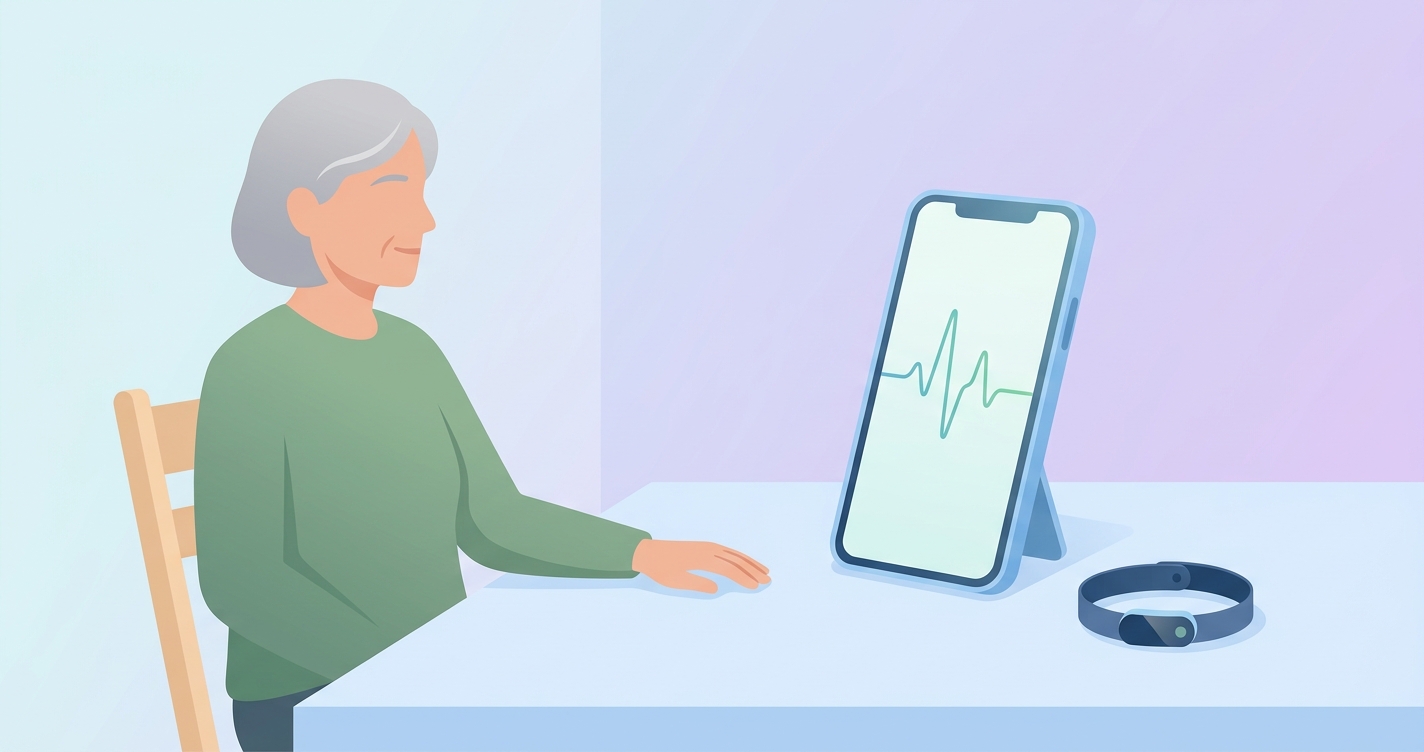
The two approaches share a goal and almost nothing else. Wearable monitoring depends on a body-worn sensor that the patient must charge, wear, sync, and tolerate continuously. Contactless monitoring, including camera-based vitals captured through a phone or tablet, depends instead on a short, deliberate check-in where the patient sits in front of a camera for roughly a minute. The first model optimizes for data density. The second optimizes for repeatable behavior.
For a chronic care management company, the contactless vs wearable monitoring choice is really a question about which failure mode is more expensive. A wearable that goes unworn produces silence that looks identical to a stable patient. A contactless check-in that is missed is visible immediately, because the expected daily action did not happen. Care teams can chase a missed action far more easily than they can detect an abandoned device buried in a drawer.
A 2024 quantitative study in JMIR Aging by researchers examining older adult populations found that continued wearable use is driven heavily by perceived usefulness and ease of integration into daily routines, factors that erode quickly in patients with multimorbidity, cognitive load, and dexterity limits. The same population is the core of most CCM panels.
| Factor | Wearable Monitoring | Contactless Monitoring |
|---|---|---|
| Patient action required | Charge, wear, sync continuously | One ~60-second camera check-in |
| Device fatigue risk | High over months | Low, no device to tolerate |
| Hardware logistics | Shipping, replacement, charging support | Uses existing phone or tablet |
| Missed-data visibility | Low; non-wear looks like stability | High; missed check-in is obvious |
| Onboarding burden for elderly | Significant | Minimal |
| Infection and skin-contact concerns | Present | None |
| Best fit | Continuous arrhythmia or activity capture | Daily trend tracking for chronic panels |
The table is not an argument that wearables lack value. Continuous capture matters for specific clinical questions such as paroxysmal arrhythmia detection. The argument is narrower: for daily trend surveillance across a chronic panel, the wearable's continuous advantage is only theoretical if the patient stops wearing it.
Why wearables underperform in chronic populations
- Device fatigue accumulates. The novelty that drives strong week-one adherence fades, and chronic patients already manage medication schedules, glucose checks, and appointments.
- Charging is a daily failure point. A wearable that dies overnight produces a gap precisely when overnight respiratory or heart rate trends matter most.
- Skin contact and comfort issues affect older and frail patients disproportionately.
- Replacement and shipping logistics create operational drag that scales badly across thousands of enrollees.
- Non-wear is invisible in dashboards, so programs overestimate the data they actually hold.
Why contactless improves compliance
- A discrete daily ritual is easier to build into a routine than continuous wear.
- No hardware to lose, break, or charge removes the most common abandonment triggers.
- A missed check-in creates an immediate, actionable signal for care managers.
- Using a device the patient already owns lowers the onboarding barrier that stalls enrollment.
Industry applications across chronic conditions
The practical case for wearable alternatives chronic disease programs becomes clearer when broken down by condition, because each disease rewards a different cadence.
Heart Failure
Heart failure management depends on catching decompensation early, often signaled by rising resting heart rate and subtle weight and respiratory changes over days. A no-device vital monitoring check-in each morning gives care teams a consistent baseline and a clean trend line, without depending on a patient remembering to wear a sensor overnight. The high cost of a single readmission makes even modest compliance gains financially meaningful.
COPD
COPD exacerbations build quietly over several days while patients still feel close to normal. Daily contactless capture of respiratory rate and heart rate creates a repeatable morning measurement that fits an established routine. Because there is no device to tolerate, patients experiencing breathlessness are not asked to manage additional hardware during the exact periods they feel worst.
Diabetes
Diabetes monitoring increasingly looks beyond glucose alone toward cardiovascular and autonomic signals. Camera-based vitals add heart rate and related trend data to the picture without adding another wearable to a patient who may already manage a glucose device. Reducing total device burden is itself an adherence strategy.
Current research and evidence
The evidence base for contactless measurement has matured quickly. A 2024 evaluation published in a peer-reviewed PMC journal assessed a camera-based remote photoplethysmography (rPPG) solution against regulated medical devices and reported heart rate, respiratory rate, and oxygen saturation estimates within roughly a few units of reference instruments, while noting that blood pressure remains more challenging. A clinical validation study of rPPG-enabled contactless pulse rate software in cardiovascular disease patients, published by MDPI, reported strong agreement with electrocardiogram measurements, indicating that camera-derived pulse rate can track reliably in a clinically relevant population.
A 2024 systematic review of non-contact vision-based vital sign monitoring in MDPI concluded that rPPG is promising for heart rate and respiratory rate, while cautioning that blood pressure accuracy still falls below acceptable medical thresholds. That nuance matters for program design: contactless methods are strongest as trend and triage tools for heart rate and respiratory rate, and weaker where they attempt to replace a validated cuff for absolute blood pressure values.
On the wearable side, the literature points consistently to adherence as the limiting factor rather than sensor accuracy. Reviews of wearable technology in chronic disease management repeatedly identify perceived usefulness, comfort, complexity, and integration into daily life as the variables that determine whether a device is still in use months later. For a value-based care organization, an accurate sensor that is no longer worn contributes nothing to total cost of care.
The combined reading of these literatures is straightforward. Wearables win on raw continuous data when worn. Contactless methods win on the behavior that determines whether any data exists at all, and they are now accurate enough for the heart rate and respiratory rate trends most chronic surveillance relies on.
The future of contactless vs wearable monitoring
The likely trajectory is not a winner-take-all outcome but a sorting by clinical question. Continuous wearables will hold ground where uninterrupted capture is genuinely required, such as ambulatory arrhythmia investigation. Contactless check-ins will become the default surveillance layer for large chronic panels where daily trend data and high compliance matter more than second-by-second resolution.
Three developments will accelerate that sorting. First, regulatory validation of camera-based measurements continues to expand, with respiratory rate and pulse rate tools moving through clearance pathways. Second, deep learning improvements in rPPG are steadily widening the range of conditions, skin tones, and lighting environments where measurement holds. Third, reimbursement structures increasingly reward documented, recurring patient engagement, which favors a model built around a visible daily action over one built around a device that may sit unused. Programs designing for the next several years will weigh contactless vs wearable monitoring less as a technology preference and more as a compliance and economics decision.
Frequently asked questions
Is contactless monitoring as accurate as a wearable?
For heart rate and respiratory rate, peer-reviewed validation studies report camera-based rPPG estimates close to reference devices. Blood pressure remains less reliable and is better handled by a validated cuff. The more decisive difference in practice is that contactless data actually gets collected, because compliance does not depend on continuous device wear.
Why do chronic patients stop using wearables?
Research on wearable adherence consistently cites charging burden, comfort, complexity, and fading perceived usefulness. These factors hit older adults with multiple conditions hardest, which is exactly the population most chronic care programs enroll.
Can a contactless program replace a wearable entirely?
For daily trend surveillance across heart failure, COPD, and diabetes panels, a wearable-free model is a workable primary approach. Specific clinical questions that demand continuous capture may still warrant a wearable, but they are the exception rather than the panel norm.
What makes contactless better for program compliance?
A short daily check-in is a discrete, repeatable action with no hardware to lose or charge, and a missed check-in is immediately visible to care managers, turning non-adherence into an actionable signal rather than silent data loss.
Circadify is building toward this wearable-free model with daily contactless check-ins designed for heart failure, COPD, and diabetes populations, removing device fatigue from the chronic monitoring equation. Chronic care management and value-based care teams evaluating a no-device approach can review program details at circadify.com/solutions/chronic-care-management.