Contactless vs Cuff: Comparing Home Blood Pressure Monitoring
A research-grounded comparison of cuff and contactless home blood pressure monitoring on adherence, accuracy, and reach for chronic care management programs.
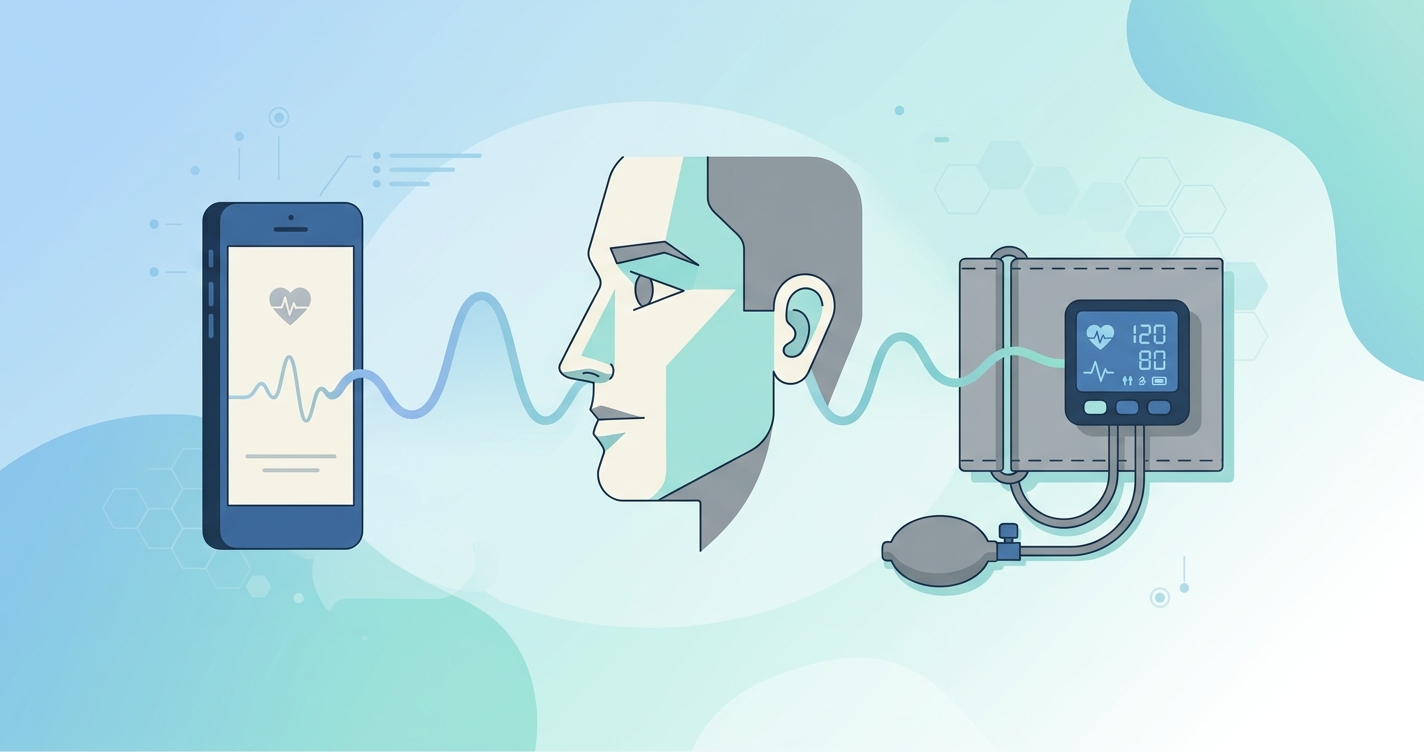
Hypertension is the most common chronic condition a value-based care program will ever manage, and it is also the one where the gap between a clinic reading and real life is widest. For chronic care management organizations and accountable care organizations, the operational question is not whether patients should track blood pressure at home, but which method actually produces usable data over months and years. That choice now sits between two approaches to home blood pressure monitoring: the validated oscillometric cuff that has anchored guidelines for decades, and phone-based contactless checks that read blood flow through a camera. Each carries a different profile on adherence, accuracy, and the share of a population a program can realistically reach.
Roughly 120 million U.S. adults have high blood pressure, yet only about one in four has it controlled to target. Home measurement is one of the few interventions shown to move that number, but only when patients actually keep measuring.
Why home blood pressure monitoring is a program design problem, not a device choice
The clinical case for home blood pressure monitoring is settled. Out-of-office readings predict cardiovascular events better than office readings, reduce therapeutic inertia, and support faster medication titration. A 2024 long-term analysis of self-monitoring paired with medication self-titration found that simple, inexpensive home programs improved blood pressure control well beyond the study period. The harder truth for program operators is that the benefit depends entirely on sustained measurement, and sustained measurement is exactly where most cuff-based programs erode.
Two failure modes recur across the literature. The first is technique and fit. Research highlighted by the American Medical Association found that a large share of U.S. adults cannot get an accurate reading from standard upper-arm cuffs because the cuff does not fit their arm circumference. The second is adherence decay: cuffs require a patient to locate the device, sit correctly, apply the cuff, stay still, and log the result, every day, indefinitely. A 2024 study reported in Pharmacy Times found a positive correlation between measurement frequency and medication adherence, which cuts both ways. Frequent measurers do better, but the population that struggles to measure frequently is precisely the high-risk group a chronic care program most needs to watch.
Contactless blood pressure shifts the friction equation. Camera-based remote photoplethysmography (rPPG) detects minute color changes in facial skin tied to each heartbeat, then applies machine learning to estimate systolic and diastolic pressure from a short recording. No cuff, no fit problem, no daily hardware ritual. The tradeoff moves to algorithm accuracy and validation breadth rather than patient compliance.
| Factor | Cuff (oscillometric) | Contactless (phone camera / rPPG) |
|---|---|---|
| Daily friction | Device retrieval, fitting, stillness, manual log | Short facial or finger scan in an app |
| Fit and sizing | Accuracy depends on correct cuff size | No cuff, no sizing failure mode |
| Validation maturity | Decades of standardized protocols | Emerging; varies by app and population |
| Adherence over months | Declines as routine burden adds up | Lower per-check burden supports daily use |
| Population reach | Requires shipping and stocking devices | Runs on a patient's existing smartphone |
| Calibration | Self-contained | Some methods need periodic cuff calibration |
| Best fit | Confirmatory and titration-grade readings | High-frequency trend capture and triage |
What each approach does well
A realistic program does not treat this as a winner-take-all decision. The two methods answer different operational questions.
- Cuffs deliver guideline-grade single readings. When a clinician needs a defensible number to start or adjust medication, a validated cuff remains the reference.
- Contactless checks deliver frequency and reach. A daily or twice-daily scan builds the trend line that reveals drift before a crisis, and it works for patients who would never sustain a cuff routine.
- Cuffs struggle with the long tail of adherence. The patients who skip the most are often the highest risk.
- Contactless struggles with the precision of any one reading. The value sits in the pattern across many readings, not a single decimal-accurate result.
- Cuffs add per-patient hardware cost and logistics. Contactless leans on hardware the patient already owns.
For cuff versus phone BP monitoring decisions, the cleanest framing is confirmation versus surveillance. Cuffs confirm. Contactless surveils. Programs that pick one and pretend it does both tend to be disappointed by whichever job they ignored.
Industry Applications
Chronic care management programs
CCM teams bill for time spent managing patients between visits, so the data that fuels those touchpoints needs to arrive consistently. Daily BP tracking through a contactless check gives care managers a steady signal to triage against, while a validated cuff stays in reserve for the smaller set of moments that demand a confirmatory reading. The combination keeps panels of several hundred patients reviewable without a device-management operation behind it.
Accountable care organizations and value-based care
For ACOs carrying downside risk, hypertension control feeds directly into quality measures and avoided cardiovascular admissions. Hypertension remote monitoring at scale is constrained by reach: every cuff that is never set up is a patient who stays invisible. Contactless checks that run on existing smartphones widen the addressable population, which matters most in the underserved groups where control rates lag and cuff fit problems are common.
Multimorbidity and medication titration
Blood pressure rarely travels alone. Patients with heart failure, diabetes, or kidney disease need blood pressure read alongside heart rate and respiratory trends. A single contactless check that captures several signals at once reduces the number of separate devices a complex patient must maintain, while the cuff remains available for the titration decisions where a precise number carries weight.
Current research and evidence
The evidence base is moving quickly but unevenly. On the cuff side, a 2024 systematic review presented in the journal Hypertension concluded that home blood pressure devices show a relatively high degree of measurement inaccuracy in real-world use, and called for standardized definitions of accuracy. That finding is a useful corrective: the cuff is the reference standard in protocol, but not flawless in the field, especially without training.
On the contactless side, validation studies in 2023 and 2024 have reported encouraging results in specific populations. A study of the WellFie rPPG application found predictive accuracy for blood pressure, heart rate, and respiratory rate comparable to clinical standards in normotensive adults. A 2023 JMIR mHealth and uHealth instrument validation of the AlwaysBP smartphone method reported acceptable agreement with cuff measurements for both systolic and diastolic pressure. A camera-based review in OAE Publishing summarized the mechanism and clinical perspective while flagging the open challenges directly: performance across diverse skin tones, the need in some methods for periodic cuff calibration, and long-term measurement stability. Reflecting the trajectory, a phone-camera blood pressure application reported receiving Class II medical certification in 2025, an early signal that regulators are beginning to engage with the category.
The honest reading of the current literature is that contactless methods are validated enough to be useful for trend capture and triage in many adults, and not yet uniformly validated as a one-to-one replacement for a cuff at the individual-reading level, particularly in hypertensive and diverse populations. That is an argument for layered design, not for waiting.
The Future of home blood pressure monitoring
Three shifts will shape the next few years. First, validation will get population-specific. Expect studies that report accuracy separately by skin tone, blood pressure range, and age rather than a single pooled error figure, which is what payers and quality programs will eventually demand. Second, the reference role of the cuff will narrow rather than disappear: cuffs will increasingly serve as periodic calibration and confirmation anchors for higher-frequency contactless streams, a hybrid that several rPPG methods already assume. Third, the unit of value will move from the reading to the trend. As daily measurement becomes frictionless, the analytic question becomes how to detect meaningful drift in a noisy daily series, which favors programs built around continuous surveillance rather than occasional snapshots.
For chronic care and value-based organizations, the strategic takeaway is that reach and adherence are becoming the binding constraints, not single-reading precision. The method that gets the most patients measuring the most often, with a cuff held in reserve for confirmation, is the one most likely to move control rates and quality scores.
Frequently asked questions
Is contactless blood pressure accurate enough to replace a cuff?
Not as a wholesale replacement yet. Current validation supports contactless checks for high-frequency trend tracking and triage in many adults, while a validated cuff remains the reference for confirmatory readings and medication titration decisions. Most programs use them together rather than choosing one.
Why does adherence favor contactless monitoring?
A cuff requires retrieving a device, fitting it correctly, staying still, and logging a result every day. A contactless scan removes the hardware ritual and runs on a phone the patient already owns, which lowers the per-check burden and supports daily BP tracking over months.
What about patients whose cuffs do not fit?
Cuff accuracy depends on matching cuff size to arm circumference, and research has found a meaningful share of U.S. adults cannot get a reliable reading from standard cuffs. Contactless methods avoid the sizing failure mode entirely, which can extend reach in populations where cuff fit is a barrier.
How should a CCM or ACO program combine the two?
Use contactless checks for daily surveillance and population reach, and reserve validated cuffs for confirmation and titration. This layered model captures the trend data that predicts events while keeping a guideline-grade reading available for clinical decisions.
Circadify is building toward this layered model of hypertension remote monitoring, with daily contactless check-ins designed to widen reach and reduce device fatigue across chronic populations. Chronic care management companies and value-based care organizations evaluating how contactless and cuff methods fit together can explore a hypertension monitoring demo and program details at circadify.com/solutions/chronic-care-management.