How Chronic Care Data Supports Quality Measure Reporting
An analysis of how chronic care data supports quality measure reporting by improving denominator accuracy, documenting follow-up, and strengthening digital reporting workflows.
How Chronic Care Data Supports Quality Measure Reporting
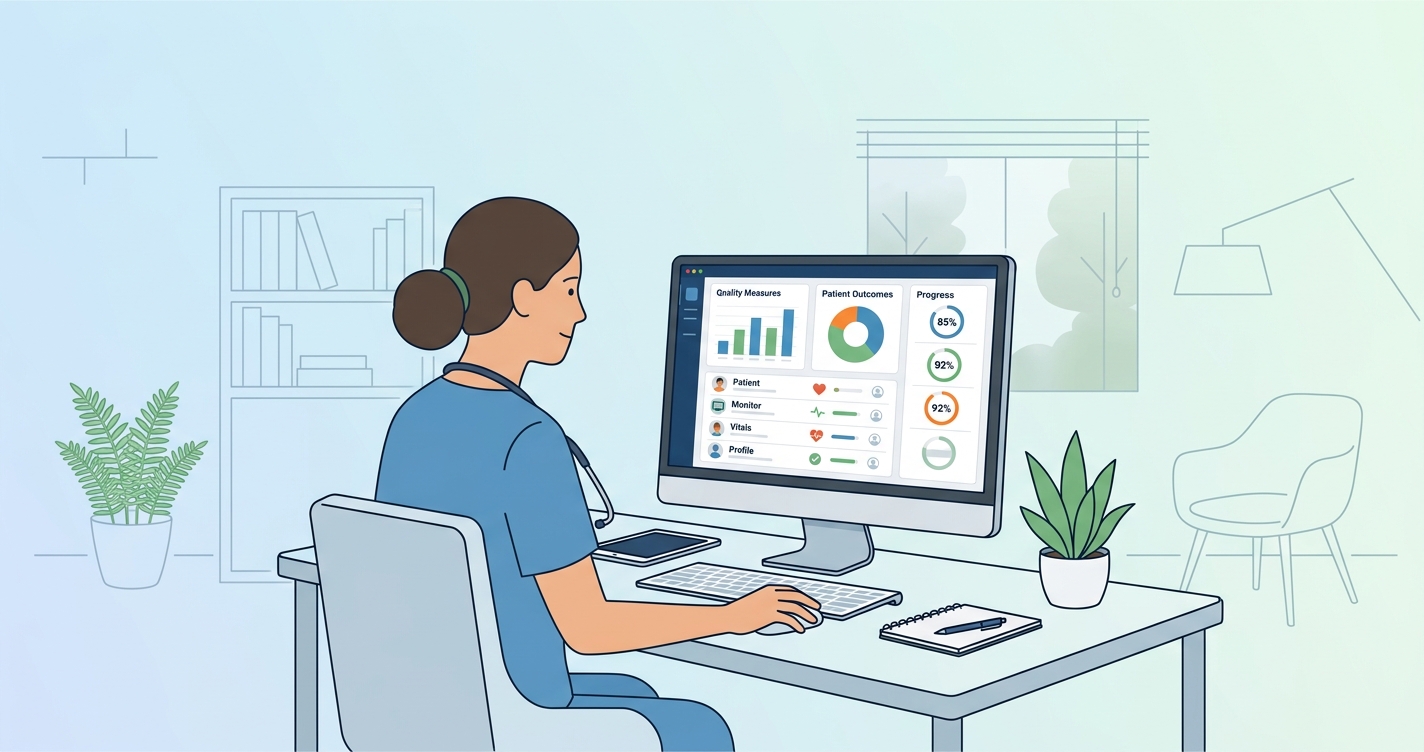
Chronic care data quality measure reporting has turned into an operations issue, not just a compliance issue. Health plans, ACOs, and chronic care management organizations are judged on whether they can show consistent follow-up, capture the right patients in the right measure populations, and document action between visits. That gets harder when the patient population includes heart failure, COPD, diabetes, hypertension, and multimorbidity all at once. In chronic care, reporting quality well usually starts with something simple: better day-to-day data.
"The digital future of HEDIS has begun. New digital measures reduce the burden of reporting quality results." — NCQA, HEDIS and Performance Measurement, accessed 2026
Why chronic care data quality measure reporting depends on data freshness
Most quality programs were built around claims files, chart review, and retrospective abstraction. That still works for some measures, but it creates a lag. By the time a team sees the gap, the measurement period may be nearly over. Chronic care programs feel this more sharply because the patients who affect measure performance are often the same patients most likely to miss visits, cycle through multiple settings, or deteriorate between encounters.
The scale of the problem is not small. NCQA says more than 235 million people are enrolled in plans that report HEDIS results, and HEDIS now includes more than 90 measures across six domains. At the same time, CDC reports that three in four American adults have at least one chronic condition and more than half have two or more. Quality teams are not reporting on a narrow edge case. They are trying to measure performance across a very large, medically complex population.
That is why fresher chronic care data matters. When organizations have more frequent information about vitals, engagement, follow-up activity, and changes in status, measure reporting becomes less dependent on late chart cleanup and more dependent on workflows that are already happening.
| Reporting need in chronic care | Retrospective model | Data-rich chronic care model |
|---|---|---|
| Denominator identification | Claims and diagnosis lag | Claims plus current clinical and program data |
| Evidence of follow-up | Manual chart checks | Structured documentation from ongoing outreach |
| Risk of missing a gap | High near year-end | Lower when gaps are visible throughout the year |
| Data sources | EHR and claims only | EHR, claims, patient-generated data, care management tools |
| Reporting cadence | End-of-period cleanup | Continuous monitoring and mid-cycle correction |
| Burden on staff | Heavy abstraction work | More automation, more exception review |
Where chronic care data helps most in measure reporting
Quality reporting is really a chain of smaller jobs. Chronic care data supports each link in that chain.
- It helps identify the right population for each measure.
- It shows whether outreach actually happened.
- It documents whether monitoring was sustained or sporadic.
- It gives teams earlier warning that a patient is drifting out of compliance.
- It supports more credible submissions when digital reporting requirements increase.
The CMS digital quality measures program is pushing in the same direction. CMS says digital quality measures use standardized digital data from one or more sources, exchanged through interoperable systems and often queried through APIs such as FHIR. The practical takeaway is clear: reporting is moving away from purely retrospective record hunting and toward computable, workflow-linked data.
For chronic care operators, that shift matters because their best data often sits outside the classic visit note. A monthly non-face-to-face CCM interaction, a daily monitoring trend, a documented escalation after a respiratory change, or a follow-up call after a missed check-in may all matter operationally before they matter analytically.
How measure performance improves when chronic care data is continuous
The strongest chronic care programs do not wait for quality season to think about evidence. They build evidence during routine operations.
Donato Giuseppe Leo of the University of Liverpool and colleagues reviewed 96 studies in Journal of Medical Internet Research in 2022 and found that interactive remote patient monitoring was associated with lower mortality, modest blood pressure improvement, and better glycated hemoglobin results versus usual care. That does not automatically translate into a better HEDIS score, but it does show why consistent monitoring data matters. If a program is better at staying connected to the patient, it is usually better at documenting ongoing management too.
Mariana Peyroteo of NOVA University of Lisbon and colleagues reached a related conclusion in a 2021 systematic review in JMIR mHealth and uHealth. Remote monitoring in primary care showed promise, but the main implementation problem was not sensor novelty. It was integration. In 83% of the reviewed interventions, the sticking point was fitting new data into existing systems and workflows. That sounds mundane, but it is exactly where quality measure reporting succeeds or fails.
In other words, chronic care data only helps quality reporting when the information can be used in the same operational path that nurses, care coordinators, quality teams, and reporting analysts already follow.
Which measures benefit most from better chronic care data
Not every measure needs daily or weekly data, but many chronic care measures benefit from more complete longitudinal information.
Medication adherence and medication management
Patients with multiple chronic conditions often move through medication changes after discharge, specialist visits, or symptom flare-ups. Structured chronic care data helps teams document outreach, reconcile therapy changes, and identify adherence risks earlier.
Blood pressure control and hypertension follow-up
For blood pressure-related reporting, the big problem is often not awareness. It is documentation and timing. A patient may have an elevated office reading, then no clean follow-up path before the reporting deadline. More frequent monitoring and outreach create a better chance to capture trend data and completed follow-up.
Diabetes monitoring and care gap closure
Diabetes measures often hinge on regular surveillance, repeat testing, and timely follow-up. Chronic care datasets help teams see which patients have gone quiet, which patients are overdue, and which patients need a second push to close the gap.
Post-discharge and utilization-sensitive measures
Programs managing heart failure, COPD, and medically complex older adults are often judged on readmissions, follow-up timing, and utilization patterns. Continuous chronic care data gives organizations a way to show that the patient did not disappear after discharge.
Readers working on adjacent workflows may also want to see our analysis of how value-based care organizations use daily vitals data and how CCM programs use contactless vitals for monthly check-ins.
Current research and evidence
A few findings matter more than the rest for teams thinking about chronic care data quality measure reporting.
- NCQA says more than 235 million people are enrolled in plans that report HEDIS results, and the measure set now spans more than 90 measures. That scale is one reason reporting workflows are moving toward more digital, less manual collection.
- CDC says three in four US adults have at least one chronic condition, and more than half have two or more. Measure reporting in chronic care is therefore a multimorbidity problem as much as a documentation problem.
- CMS says digital quality measures are meant to use standardized digital data from interoperable systems and may draw from EHRs, registries, home monitoring, patient portals, and other digital sources. That gives chronic care programs a clearer path to make nonvisit data count.
- Leo, Buckley, Chowdhury, and colleagues at the University of Liverpool reported in 2022 that interactive remote patient monitoring was linked to lower mortality and improvements in blood pressure and HbA1c across chronic conditions.
- Peyroteo, Ferreira, Elvas, Ferreira, and Lapao reported in 2021 that integration into existing primary care systems and workflows was the biggest recurring barrier in remote monitoring programs.
The common thread is not flashy analytics. It is data continuity. When teams can capture and route usable chronic care data through the systems they already depend on, reporting gets cleaner.
What quality teams actually need from chronic care datasets
Quality leaders usually do not need every possible biometric stream. They need data that is reportable, attributable, and easy to reconcile.
That usually means:
- Patient identity matched cleanly across systems
- Timestamps that show when monitoring or outreach occurred
- Structured fields rather than free text whenever possible
- Documentation of escalation, follow-up, or resolution
- Enough longitudinal detail to separate one-off contact from real management
This is where lower-friction monitoring models start to matter. If patients can complete more frequent check-ins without another device to charge, teams get a steadier flow of usable information. For chronic care populations, that improves both operational visibility and reporting readiness.
The future of chronic care data quality measure reporting
The next few years will probably bring less tolerance for fragmented reporting stacks. HEDIS is moving deeper into digital collection. CMS keeps signaling that interoperable, computable quality measurement is the destination. Chronic care organizations will feel pressure to prove not just that they touched the patient, but that the touchpoint produced data that can move through reporting pipelines without a lot of manual rescue work.
Three changes look likely.
More measure logic will depend on interoperable data
FHIR-based reporting will not remove workflow headaches overnight, but it does change the expectation. Data that sits in one note and nowhere else will be less useful than structured data that can move across systems.
Continuous monitoring will support mid-year quality correction
Instead of waiting for end-of-year abstraction, organizations will increasingly watch quality gaps as they form. Chronic care programs are well positioned for this because they already operate between visits.
Quality reporting and care management will keep merging
The old split between the team that cares for patients and the team that reports on care is getting harder to maintain. In chronic disease management, the best reporting systems are usually attached to the real outreach workflow.
Frequently asked questions
What is chronic care data quality measure reporting?
It is the use of chronic care management data, including follow-up activity, monitoring trends, outreach records, and clinical documentation, to support formal quality reporting programs such as HEDIS, Stars, and other payer or CMS-aligned measures.
Why does chronic care data help HEDIS reporting?
It gives plans and providers more complete longitudinal evidence. That helps identify denominator populations, document care gap closure, and reduce the amount of missing information discovered late in the reporting cycle.
Which data sources matter most for chronic care quality reporting?
EHR data and claims still matter, but CMS's digital quality measure model also points to registries, patient portals, home monitoring, and other interoperable digital sources as part of the reporting future.
Does remote monitoring automatically improve quality scores?
No. Better monitoring helps only when the data is integrated into workflows, documented in structured ways, and tied to outreach or follow-up actions that count in reporting.
Quality measure reporting gets easier when chronic care data stops arriving as a pile of disconnected facts and starts arriving as a usable timeline. For CCM companies, ACOs, and value-based care teams, that is the real opportunity: turn daily management into cleaner reporting instead of treating reporting as a separate annual project. Solutions like Circadify's chronic care management workflows are built around that same idea: capture low-friction patient data more consistently so care teams can act earlier and document care more completely.