How can I check on my elderly dad's breathing from my phone without disturbing him?
How contactless COPD daily vital signs monitoring lets adult children check a parent's breathing from a phone without intruding, and why ACOs are paying attention.
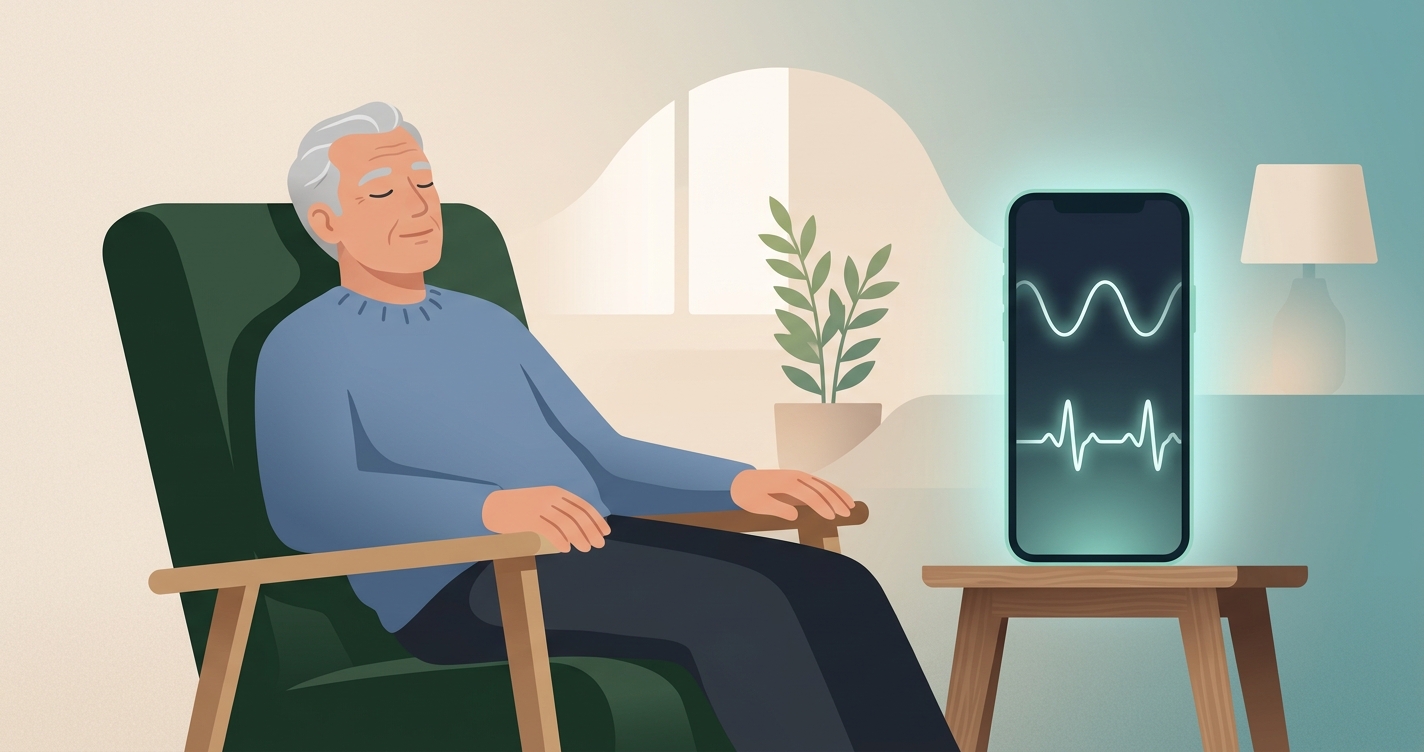
The question sounds simple, but it carries the weight of a whole family. An adult child wants to know whether a parent with chronic obstructive pulmonary disease is breathing comfortably tonight, without knocking on the bedroom door, without strapping a device to a tired wrist, and without turning every evening into a wellness audit. That tension between vigilance and intrusion is now one of the central design problems in chronic care, and it is exactly where contactless COPD daily vital signs monitoring is starting to matter for families and for the organizations that serve them.
COPD is not a rare worry. According to the CDC National Center for Health Statistics (NCHS Data Brief, 2025), roughly 11.7 million U.S. adults were living with diagnosed COPD in 2023, prevalence rose to 10.5% among adults aged 75 and older, and the disease was the fifth leading cause of death that year with 141,733 deaths. Most of those people live at home, and most of the daily watching falls to a spouse or an adult child.
Family caregivers of people with advanced COPD report social and leisure restriction in 82.9% of cases and direct health problems in 35.4%, while the estimated annual value of unpaid family caregiving in the United States reached roughly $600 billion. - AARP, Valuing the Invaluable 2023 Update, and Cruz et al., caregiver burden research
Why COPD daily vital signs are hard to watch without intruding
The core difficulty is that the most useful COPD daily vital signs change quietly. Respiratory rate, heart rate, and oxygenation often drift in the wrong direction days before a person feels short of breath enough to mention it. A systematic review of remote vital sign monitoring in COPD (published in the journal Sensors and indexed in PubMed Central, 2023) found that respiratory rate and heart rate trends are among the more promising early signals of an exacerbation, but the same review noted that adherence to wearable and manual measurement falls off sharply over time.
That is the heart of the caregiver's problem. The data that would reassure an adult child is precisely the data a tired, breathless parent is least likely to collect on their own. Asking your dad to clip on a pulse oximeter every morning, log a number, and text it to you turns him into a part-time medical technician and turns you into a supervisor. Most families abandon that arrangement within weeks.
Contactless approaches change the question. Instead of asking the patient to do something, the measurement happens passively, often through a camera-based technique called remote photoplethysmography (rPPG) that reads tiny color and motion changes in the face and chest to estimate heart rate and breathing rate. The check-in becomes part of an ordinary moment, such as a short video greeting, rather than an extra chore layered onto a hard day.
Here is how the common options compare from a caregiver's point of view.
| Monitoring approach | Patient effort | Disturbance level | Daily trend data | Caregiver visibility |
|---|---|---|---|---|
| Manual oximeter and notebook | High, daily | Moderate, interrupts routine | Inconsistent, often skipped | Delayed, depends on patient reporting |
| Wearable wrist device | Medium, charging and wearing | Low to moderate, comfort issues | Good when worn | Good but adherence drops |
| In-room bedside sensor | Low | Low, fixed location only | Good in one room | Good but location-bound |
| Contactless phone or tablet check-in | Very low | Very low, blends into daily contact | Good with daily use | Direct, near real time |
A few practical points stand out for families weighing these options:
- Effort and adherence are linked. The lower the daily burden on the patient, the more complete the trend data tends to be over months.
- A single number is less useful than a trend. One oxygen reading can mislead. A two-week pattern in resting respiratory rate is far more informative.
- Disturbance is not only physical. Constant questions about symptoms can strain the relationship as much as a poorly fitting device strains the wrist.
- Visibility should be shared, not surveillant. The goal is a parent who feels supported, not watched.
Industry applications for ACOs and chronic care programs
For accountable care organizations and chronic care management companies, the family caregiver is not a side character. They are often the difference between a managed condition and an avoidable hospitalization. Reducing caregiver burden while improving COPD daily vital signs visibility serves both the patient and the value-based contract.
Family engagement as a clinical asset
When an adult child can glance at a simple trend rather than interrogate a parent, the family becomes a reliable early-warning layer between scheduled visits. Programs that bring caregivers into the data loop tend to see faster reporting of subtle changes, which is exactly the window in which an exacerbation can be treated at home rather than in an emergency department.
Reducing caregiver burnout and turnover
Caregiver strain is a measurable cost. Research on COPD caregivers (Cruz and colleagues, and related burden studies indexed in PubMed Central) documents high rates of anxiety, fatigue, and lost work time, with occupational problems reported by roughly 37.3% of working-age caregivers. A caregiver who burns out is a caregiver who can no longer keep a parent safely at home, which pushes cost and risk back onto the system. Unobtrusive monitoring is partly a clinical tool and partly a way to protect the unpaid workforce that value-based care quietly depends on.
Fitting existing reimbursement and workflows
Contactless daily check-ins generate the kind of recurring physiologic and engagement data that chronic care management and remote monitoring programs already build their workflows around. The family-facing view sits on top of the same data stream that care managers use to triage, so a single daily measurement can serve the patient, the adult child, and the clinical team at once.
Current research and evidence
The evidence base for contactless vital sign measurement has matured quickly. Multiple peer-reviewed evaluations of rPPG have reported that camera-based heart rate and respiratory rate estimates can track reference monitors closely under reasonable lighting and positioning, and a 2024 review in Frontiers summarized how deep learning has improved signal extraction from ordinary video. A digital health evaluation published in JMIR mHealth and uHealth reported reliable contactless measurement of heart rate and breathing rate during sleep in older adults, a population directly relevant to the elderly-parent scenario.
For COPD specifically, the systematic review of remote vital sign monitoring (PubMed Central, 2023) is cautious but constructive. It concludes that respiratory rate and heart rate trends carry real signal for exacerbation detection, that patient adherence is the recurring failure point of older methods, and that lower-burden measurement is the most plausible path to consistent long-term data. Contactless capture is not a cure, and no responsible program presents it as a diagnostic guarantee, but it directly addresses the adherence gap the literature keeps identifying.
What the research does not yet fully settle is standardization. Reviewers note that contactless methods still lack uniform validation protocols across lighting, skin tone, and device types, which is an active area of study rather than a solved problem.
The future of contactless COPD monitoring
The near-term direction is clear. Measurement is moving away from the patient as an active operator and toward passive capture during moments that already happen, such as a daily video call between a parent and a child. As models improve, a single brief interaction may yield respiratory rate, heart rate, and trend context, with the clinical team and the family seeing tailored views of the same underlying data.
The larger shift is cultural. The next decade of chronic care will likely treat the family caregiver as a formal participant in the care plan rather than an informal afterthought. Tools that lower the daily ask on the patient while raising shared visibility fit that direction precisely, and they align with where value-based contracts are pushing: fewer avoidable admissions, more time at home, and a caregiving relationship that does not collapse under the weight of monitoring.
Frequently asked questions
Can a phone really measure breathing without touching my dad? Camera-based methods such as remote photoplethysmography estimate breathing and heart rate from subtle changes in skin color and chest movement captured on video. Peer-reviewed studies report these estimates can track reference devices well under good conditions, though they are best treated as trend indicators rather than a substitute for clinical diagnosis.
Will this wake him up or interrupt his routine? That is the point of contactless monitoring. There is nothing to wear, charge, or clip on. A measurement can happen during an ordinary daily video greeting, so the check-in blends into normal family contact instead of becoming a separate medical task.
What COPD daily vital signs matter most for spotting trouble early? Research highlights resting respiratory rate and heart rate trends as useful early signals of a brewing exacerbation, often shifting before a person notices worse breathlessness. A multi-day pattern is far more meaningful than any single reading.
How does this help if my dad is in a chronic care or ACO program? The same daily measurement can feed the clinical team's dashboard and a simpler family view at once. That gives care managers earlier signals and gives you reassurance, while reducing the daily burden that wears caregivers down.
Circadify is building toward exactly this kind of low-burden, family-aware chronic care, where a daily contactless check-in serves the patient, the adult child, and the care team from one measurement. To see how this fits into a chronic care management program, visit circadify.com/solutions/chronic-care-management.