How Cardiology Practices Use Remote Vitals Monitoring
An analysis of how cardiology practices use remote vitals monitoring for heart failure, hypertension, and post-discharge surveillance across ambulatory care workflows.
How Cardiology Practices Use Remote Vitals Monitoring
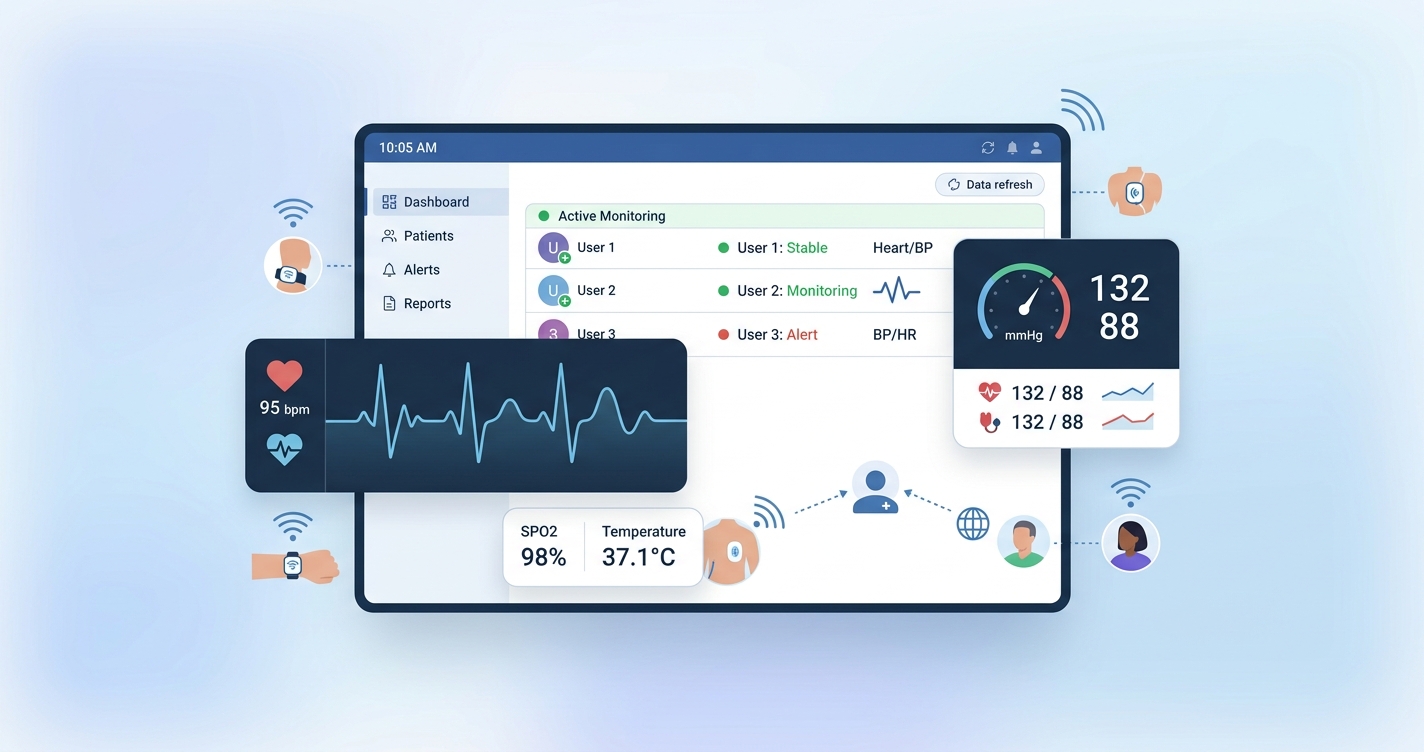
Cardiology remote vitals monitoring is moving from pilot programs into normal ambulatory operations. For cardiology groups managing heart failure, hypertension, arrhythmia risk, and post-discharge follow-up, the real value is not just getting more numbers. It is seeing physiologic change sooner, ranking which patients need contact today, and extending oversight between office visits without asking every patient to manage another complex device routine.
"Remote patient monitoring has the potential to transform heart failure care by enabling earlier detection of decompensation and more timely intervention." — Biykem Bozkurt, MD, PhD, Baylor College of Medicine, Circulation: Heart Failure, 2024
Why cardiology remote vitals monitoring now matters more in outpatient care
Cardiology practices are under pressure from both directions. Patients with chronic cardiovascular disease need more follow-up between visits, while clinics still have to control staffing load, reduce avoidable admissions, and show value in longitudinal care. That is why remote monitoring has become an operational issue, not just a digital health trend.
Heart failure is a big part of that shift. In a 2025 meta-analysis in the European Journal of Heart Failure, Ignace L.J. De Lathauwer, Wessel W. Nieuwenhuys, Frederique Hafkamp, Marta Regis, Rutger W.M. Brouwers, Mathias Funk, and Hareld M.C. Kemps reviewed 41 studies covering 16,312 patients and found that remote patient monitoring was associated with lower mortality risk and lower risk of first heart failure hospitalization. That kind of evidence matters to cardiology groups because it points to a practical payoff: more visibility between visits can translate into fewer acute escalations.
A 2024 review in Circulation: Heart Failure also argued that remote monitoring helps address one of cardiology's oldest problems: outpatient deterioration is often detected late. By the time a patient reports worsening dyspnea, edema, palpitations, or fatigue, the physiologic drift has usually been underway for days.
| Cardiology workflow question | Visit-based cardiology model | Remote vitals monitoring model |
|---|---|---|
| When does worsening become visible? | At next office visit or after symptom escalation | During daily or near-daily trend review |
| Which patients get prioritized first? | Static diagnosis lists and recent discharges | Patients with meaningful change from baseline |
| What data supports nurse outreach? | Intermittent snapshots | Ongoing heart rate, blood pressure, SpO2, weight, or trend data |
| Best fit for heart failure follow-up | Reactive | More proactive |
| Burden on staff | Heavy manual triage | Better ranking if dashboards are configured well |
| Burden on patients | Travel or device-heavy routines | Can be lower with simpler check-ins |
Cardiology groups usually care less about novelty than about whether monitoring changes workflows in a measurable way. The strongest programs make it easier to answer a simple morning question: which patients look different from yesterday?
What cardiology practices are actually monitoring
Remote monitoring in cardiology is rarely one-size-fits-all. Different clinics use different combinations depending on the population.
Common inputs include:
- Heart rate trends for baseline change, medication effects, and recovery patterns
- Blood pressure for hypertension management and medication titration
- Weight change for heart failure fluid surveillance
- SpO2 and respiratory status for patients with overlap between cardiac and pulmonary disease
- Symptom prompts tied to dyspnea, fatigue, edema, dizziness, or chest discomfort
- Adherence signals, including missed check-ins after discharge
The more mature cardiology practices focus on trends, not isolated numbers. A patient whose resting heart rate rises over three days, whose blood pressure becomes more variable, or whose daily engagement suddenly drops may deserve outreach sooner than a patient with one borderline reading.
That point came through clearly in ACC's 2024 coverage of remote patient monitoring for heart failure. The discussion emphasized that RPM works best when it supports faster medication review, closer post-discharge observation, and triage based on change over time rather than on a single abnormal value.
Where cardiology remote vitals monitoring fits best
Some cardiovascular use cases are especially well matched to between-visit monitoring.
Heart failure surveillance
Heart failure remains the clearest use case because deterioration often appears gradually. Small changes in heart rate, respiratory status, weight, or patient-reported symptoms can show up before an ED visit. For cardiology practices, that makes remote monitoring useful after hospitalization, during medication adjustment, and in chronic surveillance for higher-risk patients.
Hypertension management between office visits
Ambulatory blood pressure patterns tell cardiologists more than sporadic in-clinic readings. Ongoing home or remote capture helps distinguish persistently uncontrolled patients from people whose office measurements are misleading or inconsistent.
Post-discharge monitoring
The first few weeks after discharge are when cardiology groups often worry about readmission risk, medication confusion, and missed follow-up. A monitoring workflow can give nurses and care managers a short interval view instead of waiting for the next appointment.
Chronic disease overlap populations
Many cardiology patients also have COPD, diabetes, kidney disease, or frailty. Those patients are hard to manage with device-heavy programs because each condition tends to add another workflow. Lower-friction remote vitals capture is attractive precisely because it can support broader longitudinal monitoring.
What separates strong cardiology programs from weak ones
The literature is fairly clear on one point: remote monitoring only works when somebody acts on the data.
In the 2025 De Lathauwer meta-analysis, some program components stood out. Self-management modules, education components, and video communication were associated with stronger hospitalization reduction. That suggests the useful version of remote monitoring is not passive data collection. It is monitoring linked to a response pathway.
In practice, cardiology clinics usually need four pieces working together:
- A defined high-risk cohort, often heart failure and recent discharge patients first
- A low-friction capture model that patients will actually complete
- Thresholds based on baseline change, not just universal cutoffs
- A response owner, usually a nurse, care manager, or clinician who can escalate quickly
Programs struggle when data arrives but nobody owns the next step. They also struggle when the patient workflow is too demanding. Device setup, syncing, charging, and replacement all reduce participation over time, especially in older populations with multimorbidity.
Readers looking at adjacent chronic care workflows may also want to see our analysis of how contactless monitoring helps heart failure patients at home and how value-based care organizations use daily vitals data.
Current research and evidence
Several findings matter for cardiology leaders evaluating remote vitals monitoring today:
- Biykem Bozkurt and colleagues wrote in Circulation: Heart Failure in 2024 that remote monitoring can improve heart failure management by identifying decompensation earlier and supporting more timely intervention in outpatient care.
- Ignace L.J. De Lathauwer, Wessel W. Nieuwenhuys, Frederique Hafkamp, Marta Regis, Rutger W.M. Brouwers, Mathias Funk, and Hareld M.C. Kemps reported in the European Journal of Heart Failure in 2025 that a meta-analysis of 41 studies with 16,312 patients linked RPM to lower mortality risk and lower first heart failure hospitalization risk.
- The same meta-analysis found that programs with self-management, education, and video communication components produced stronger reductions in heart failure-related hospitalization.
- ACC's 2024 review of remote patient monitoring for heart failure framed RPM as a way to support earlier intervention, medication optimization, and tighter follow-up for ambulatory cardiology populations.
The practical takeaway is fairly grounded. Cardiology practices do not need endless streams of physiologic data. They need enough reliable signal to decide who to call, what to adjust, and when to pull someone back into care before symptoms become severe.
Why lower-friction monitoring is getting attention in cardiology
Many cardiology patients are already carrying a heavy treatment burden. They may be dealing with polypharmacy, repeated appointments, rehabilitation recommendations, and multiple specialists. Adding another device can help in some cases, but it can also reduce adherence.
That is why contactless and camera-based approaches are getting a closer look in longitudinal cardiology workflows. A simpler check-in model may not replace every specialized device, but it can expand coverage for patients who would otherwise fall out of routine monitoring. For cardiology practices, that is often the tradeoff that matters most: slightly less complexity per patient, but meaningfully more participation across the panel.
The future of cardiology remote vitals monitoring
The next stage will probably be less about collecting more data and more about making monitoring fit normal clinic operations.
More baseline-aware triage
Cardiology teams are moving toward change detection rather than blunt thresholds. A patient's own baseline is usually more informative than a universal benchmark.
Tighter integration with chronic care workflows
Remote monitoring will increasingly feed the same nurse call, medication review, and escalation pathways that clinics already use for high-risk cardiovascular patients.
Simpler patient experiences
The programs most likely to scale are the ones that reduce setup friction. If patients can complete short daily check-ins without managing another hardware routine, adherence usually improves.
Frequently asked questions
How do cardiology practices use remote vitals monitoring?
Most cardiology practices use remote vitals monitoring to follow higher-risk patients between visits, especially people with heart failure, hypertension, or recent hospital discharge. The goal is to spot meaningful physiologic change sooner and prioritize outreach.
Which cardiology patients benefit most from remote monitoring?
Heart failure patients, recent discharges, patients with unstable blood pressure, and people with multiple chronic conditions often benefit most because deterioration can happen between appointments.
What vital signs matter most in cardiology remote monitoring?
Heart rate, blood pressure, weight, SpO2, respiratory status, and symptom trends are common inputs. The exact mix depends on the condition being followed and the practice workflow.
Why are cardiology groups interested in lower-friction monitoring models?
Because adherence is often the limiting factor. If patients will not wear, charge, sync, or regularly use a device, the clinic gets no useful signal. Lower-friction workflows can increase participation.
For cardiology practices, the point of remote vitals monitoring is not to create another dashboard full of unread numbers. It is to keep a better watch on patients who tend to worsen between visits and to make earlier intervention realistic at scale. Solutions like Circadify's chronic care monitoring approach are being built around that need: more frequent patient signal, less device fatigue, and a workflow cardiology teams can actually use.