Can my phone really tell if my heart is struggling before I feel sick?
How heart failure home monitoring and contactless check-ins surface early warning signs days before symptoms appear, and what it means for value-based care.
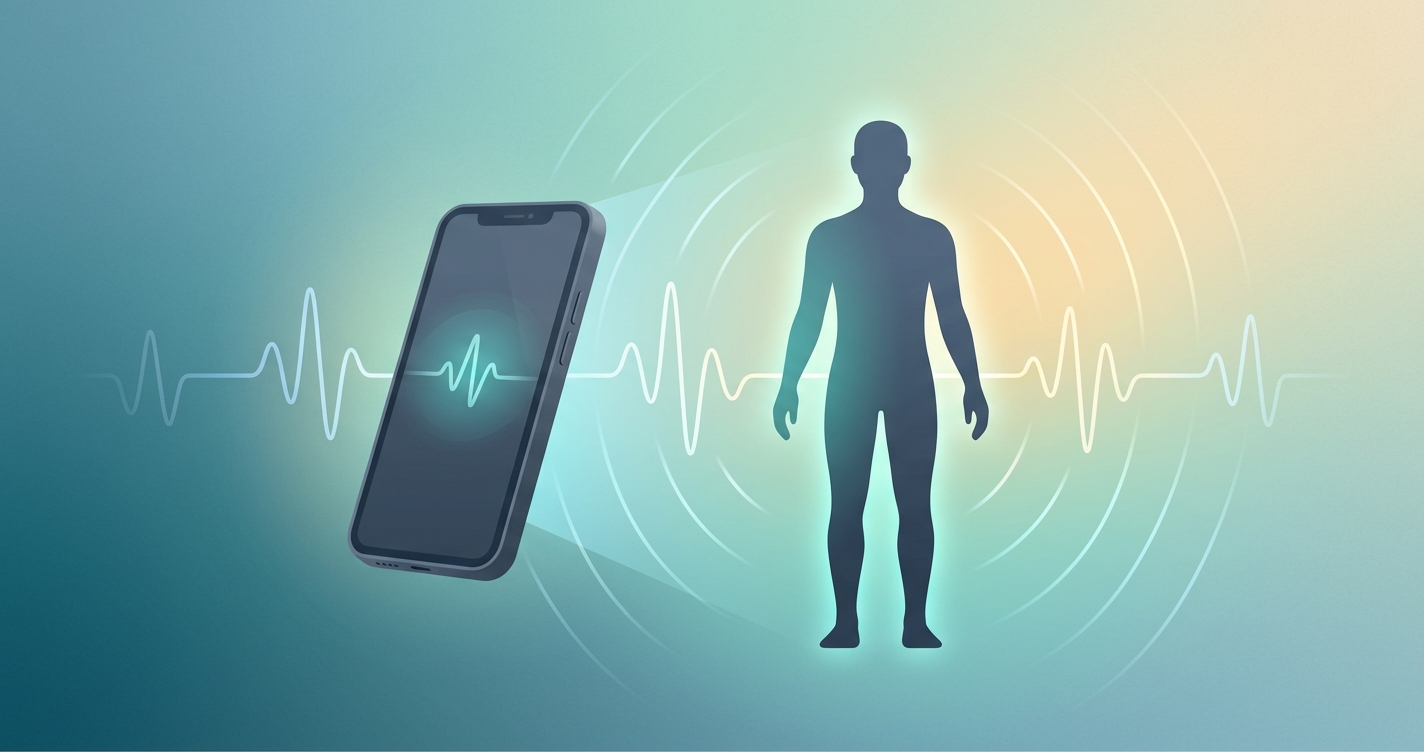
If you live with heart failure, the scariest part is often not the diagnosis itself. It is the gap between visits, the worry that your body is quietly filling with fluid while you feel more or less fine, and that by the time you notice the swelling, the breathlessness, or the weight gain, you are already on your way to the emergency department. That fear is well founded. Decompensation rarely announces itself the morning it sends someone to the hospital. It builds for days. The promising news is that heart failure home monitoring has reached a point where a camera, a phone, or a tablet can pick up subtle physiological shifts before a person feels sick, and those signals are exactly what care teams need to step in early.
A 2023 analysis of AI-based remote monitoring reported sensitivity of 76 to 87.5 percent and specificity around 85 percent for predicting heart failure hospitalization, with a median lead time of 6.5 to 8.5 days before admission.
What heart failure home monitoring actually detects
Your phone is not reading your mind, and it is not diagnosing you. What modern heart failure home monitoring does is track patterns in measurable signals that tend to drift in the days before a decompensation event. The body compensates for worsening heart function long before a patient registers a symptom. Resting heart rate creeps up. Heart rate variability narrows. Breathing rate rises slightly. These changes are small on any single day, which is precisely why people miss them. Software does not.
Contactless approaches use the camera on a standard device to measure subtle color changes in the skin caused by blood flow, a technique called photoplethysmography. From a 30 to 60 second facial scan, the system can estimate heart rate, respiratory rate, and heart rate variability without a cuff, a chest strap, or a finger clip. For someone tired of devices, that difference matters. Adherence is the quiet failure point of most remote programs, and a check-in that requires no charging, no syncing, and no wearing is far easier to sustain day after day.
The clinical logic behind this is not new. The CardioMEMS pulmonary artery pressure sensor demonstrated years ago that hemodynamic changes precede symptoms, often by days. The newer idea is delivering an early warning without an implant or a body-worn sensor, using equipment patients already own.
Why early matters more than precise
A common objection is that contactless readings are not as exact as a hospital-grade monitor. That is true, and it is also beside the point for trend monitoring. Decompensation prediction depends on change over time, not a single perfect measurement. A resting heart rate that climbs from 68 to 82 over four days is a meaningful signal even if each individual reading carries a margin of error. The goal is to catch the direction of travel early enough to adjust a diuretic dose by phone rather than admit a patient by ambulance.
| Monitoring approach | Setup burden | Daily effort | Early warning lead time | Adherence risk |
|---|---|---|---|---|
| Implanted hemodynamic sensor | Surgical procedure | Passive | Days before symptoms | Low, but invasive |
| Wearable patch or strap | Device fitting | Must wear and charge | Days before symptoms | High, device fatigue |
| Connected scale and cuff | Multiple devices | Several manual steps | Variable | Moderate |
| Contactless camera check-in | None | One short scan | Days before symptoms | Lower, no device |
The pattern across these options is consistent: the methods that demand the least from the patient tend to produce the most continuous data, and continuous data is what makes early warnings possible.
What the daily signals look like
Care teams watching heart failure home monitoring data typically pay attention to a handful of converging trends rather than any one number:
- A steady upward drift in resting heart rate over several days
- A narrowing of heart rate variability, which often reflects rising sympathetic stress
- An increase in resting respiratory rate, an early marker of fluid in the lungs
- Sudden weight gain when a scale is part of the program
- Self-reported symptoms like fatigue or swelling logged alongside the vitals
No single one of these is decisive. Together, and especially when several move in the same direction at once, they form the kind of risk signal that algorithms such as TriageHF were built to flag.
Industry applications for value-based care
For accountable care organizations and chronic care management companies, the appeal of heart failure home monitoring is not the technology for its own sake. It is the economics and the outcomes. Heart failure is the leading cause of hospitalization among adults over 65 in the United States, and readmissions carry both financial penalties and real human cost.
Reducing avoidable admissions
The BMAD trial, presented in 2023, reported a 38 percent reduction in heart failure related rehospitalizations in the group using remote monitoring. A separate 2023 retrospective cohort study of smartphone-based monitoring in patients with reduced ejection fraction found a lower hazard of emergency department visits and unplanned admissions. For a value-based organization carrying risk on a heart failure population, that kind of shift moves the entire economic model.
Prioritizing scarce clinical attention
A care manager cannot call every patient every day. Contactless check-ins let teams triage by exception, surfacing the handful of patients whose trends are deteriorating so that nurses spend their time where it changes outcomes. This is the operational reason daily contactless data tends to outperform monthly phone calls: the signal arrives while there is still time to act.
Closing the engagement gap
Programs built on wearables consistently lose patients to device fatigue. Removing the device removes the most common reason people drop out, which keeps more of a panel under active observation and protects the data continuity that early warning depends on.
Current research and evidence
The evidence base for early detection continues to strengthen. A 2023 study of remote monitoring through cardiac implantable devices found that patients with medium and high Heart Failure Risk Status were significantly more likely to experience an acute decompensation event within 30 days, validating the idea that physiological signals stratify risk well in advance. A JACC scientific statement in June 2023 framed the requirements for success clearly: dynamic signals, effective algorithms, and multidisciplinary teams acting on the data.
On the contactless side, research in 2024 on camera-based photoplethysmography confirmed both the potential and the honest limitations of the method. Accuracy can be affected by motion, ambient light, and skin pigmentation, and ongoing work in signal processing and machine learning aims to improve robustness across diverse populations. Responsible programs treat contactless vitals as a trend and triage tool, not a diagnostic replacement, and pair the data with clinical judgment.
The future of heart failure home monitoring
The direction is toward fusion. Rather than one signal, the most useful systems will combine contactless vitals, occasional weight measurements, and patient-reported symptoms into a single risk score that updates daily. Expect prediction models to grow more personalized, learning each patient's individual baseline so that a meaningful change is judged against that person rather than a population average. And as reimbursement for chronic care management and remote monitoring matures, the friction of capturing daily data without a device will make broad, sustained monitoring practical for populations that wearables never reached. The end state is simple to describe and hard to build: a system that notices your heart is struggling while there is still time to do something gentle about it.
Frequently asked questions
Can a phone actually detect heart problems before I feel symptoms? A phone cannot diagnose heart disease, but it can track vital sign trends like resting heart rate, heart rate variability, and breathing rate that often shift in the days before heart failure decompensation. Research has documented lead times of roughly 6.5 to 8.5 days before hospitalization, giving care teams a window to intervene.
Is contactless monitoring as accurate as a hospital monitor? For a single precise reading, no. For tracking change over time, it is well suited, because early warning depends on the direction of a trend rather than one exact value. Accuracy can be affected by movement, lighting, and skin tone, which is why results are used alongside clinical review.
Do I need to wear or charge anything? No. Contactless check-ins use the camera on a standard phone or tablet to capture a short scan. There is nothing to strap on or charge, which is one reason adherence tends to hold up better than with wearable devices.
Who sees the data? In a chronic care or value-based program, your readings flow to a care team dashboard where nurses and care managers watch for concerning trends and reach out when something changes, rather than waiting for your next scheduled visit.
Circadify is building daily contactless check-ins for heart failure, COPD, and diabetes so that value-based care organizations can catch deterioration earlier without adding to device fatigue. To see how this fits a chronic care management program, explore Circadify's chronic care management solution.