Camera-Based Monitoring for Multiple Chronic Conditions
An analysis of how camera-based monitoring supports patients with multiple chronic conditions through lower-friction daily vitals, earlier trend detection, and scalable chronic care workflows.
Camera-Based Monitoring for Multiple Chronic Conditions
Camera monitoring multiple chronic conditions is getting attention for a simple reason: multimorbidity breaks single-condition workflows. A patient with heart failure, diabetes, and COPD does not live inside one disease program. They move across medications, symptoms, care teams, and reimbursement models, while the physiology that signals trouble often changes before anyone schedules the next check-in. For chronic care organizations, the real question is not whether remote monitoring matters. It is whether monitoring can stay simple enough for patients who are already overloaded.
"People living with multiple chronic conditions account for 71% of all health care spending and 93% of Medicare spending." — Agency for Healthcare Research and Quality, Multiple Chronic Conditions Chartbook
Why camera-based monitoring matters in multiple chronic conditions
Multimorbidity is now the operating reality for chronic care. A 2026 CDC analysis of Behavioral Risk Factor Surveillance System data found that 78.8% of U.S. adults age 65 and older were living with multiple chronic conditions in 2023. That scale changes the monitoring problem. Care teams are no longer managing one diagnosis and one device. They are trying to maintain visibility across overlapping cardiometabolic, respiratory, and functional risks.
Traditional remote monitoring programs often fragment that work. A heart failure patient may receive a scale. A hypertension patient may get a cuff. A COPD patient may use a pulse oximeter. A diabetic patient may have a glucose workflow on top of that. The result is predictable: too many devices, too many steps, and too much opportunity for patients to disengage.
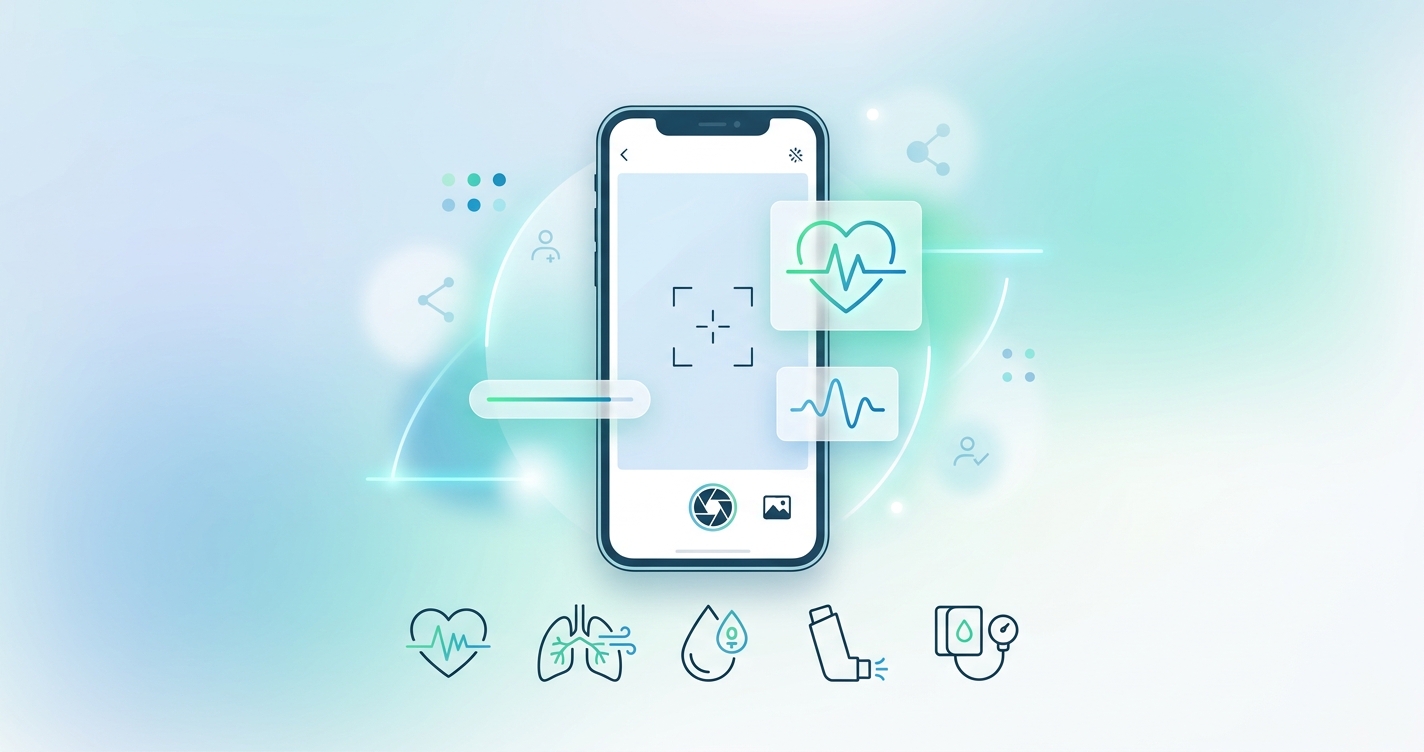
Camera-based monitoring offers a different operating model. A phone, tablet, or kiosk camera can capture short daily readings that reflect heart rate, respiratory rate, heart rate variability, and related trend data without adding another wearable to the stack. For multimorbid patients, that lower-friction model matters because the burden of the workflow is often what determines whether any data gets captured at all.
Donato Giuseppe Leo and colleagues wrote in a 2022 Journal of Medical Internet Research systematic review and meta-analysis that interactive remote patient monitoring across cardiovascular disease, COPD, and diabetes was associated with lower mortality and improvements in blood pressure and glycated hemoglobin, while adherence and satisfaction were generally favorable. The bigger lesson is not that every program works the same way. It is that frequent signal matters when the care team can respond.
| Monitoring model for multimorbid patients | Device-heavy approach | Camera-based approach |
|---|---|---|
| Patient setup | Multiple devices, charging, syncing, replacements | Existing phone, tablet, or kiosk |
| Conditions covered | Often condition-specific by device | Broader daily physiologic trend capture |
| Staff workflow | Separate dashboards and outreach rules | One lightweight check-in feeding chronic care workflows |
| Patient burden | High, especially with polypharmacy and frailty | Lower, because no wearable is required |
| Best use case | Intensive monitoring for a narrow cohort | Scalable screening and trend monitoring across complex panels |
| Primary value | Detailed single-condition readings | Better participation and earlier change detection |
The practical point is easy to miss: in chronic care, a simpler workflow that reaches more patients often creates more value than a more complicated workflow that only the most organized patients complete.
What makes multiple chronic conditions different from single-disease monitoring
Patients with multiple chronic conditions do not deteriorate in neat disease silos.
A few common examples:
- A COPD flare can drive respiratory rate changes before the patient calls anyone.
- Fluid retention in heart failure can raise resting heart rate and reduce tolerance for daily activity.
- Diabetes, infection, poor sleep, and medication nonadherence can all show up as small physiologic drift rather than one obvious event.
- Behavioral health comorbidities can reduce engagement just when more frequent monitoring is needed.
That is why multimorbidity programs usually care more about trajectory than one isolated reading. A review in BMC Primary Care by Maria Marcolino and colleagues found that remote monitoring systems in primary care improved disease control and care management in several chronic conditions, while also noting that implementation and workflow design strongly shaped results. That finding lines up with what chronic care operators see on the ground. Data matters, but only if it arrives often enough and fits the actual work of outreach, escalation, and follow-up.
For camera-based monitoring, the opportunity is not to replace every other tool. It is to provide one low-friction, repeatable daily interaction that can surface which complex patients may need more attention today.
Where camera-based monitoring fits in chronic care workflows
Chronic care management companies and value-based care organizations usually need three things at once:
- Broad patient participation
- Trend visibility between visits
- A workflow that lets staff prioritize who needs outreach first
Camera-based monitoring is attractive because it maps well to those needs.
Broader panel coverage
The most fragile patients are often the least likely to tolerate another device program. Some have dexterity issues. Some forget charging steps. Some live with caregiver turnover. Some simply stop engaging after the first few weeks. A camera-based check-in reduces those friction points.
Better detection of multi-condition drift
In multimorbidity, early decline often appears as a cluster of small changes rather than one dramatic threshold crossing. Care teams may notice:
- resting heart rate moving upward over several days
- respiratory rate rising from a patient's baseline
- lower check-in consistency after discharge or medication changes
- HRV shifts that suggest physiologic stress
Those trends do not diagnose the problem by themselves. They do help staff decide who needs a call, a nurse review, a telehealth visit, or an earlier clinic appointment.
One workflow instead of several disconnected ones
If one daily check-in can feed a CCM dashboard, it becomes easier to build a practical operating model around it. The care manager is not juggling as many one-off device exceptions. They are looking for which patients changed and what should happen next.
Readers looking at adjacent chronic care workflows may also want to review our analysis of how contactless monitoring helps heart failure patients at home and how ACOs monitor high-risk patients between visits.
Industry applications for camera monitoring multiple chronic conditions
Heart failure plus diabetes
This is one of the most expensive combinations in chronic care because medication changes, renal stress, and adherence issues can turn into acute events quickly. A lightweight daily camera-based check-in can help care teams watch for trend changes that justify earlier outreach, especially after discharge or medication titration.
COPD plus cardiovascular disease
Respiratory and cardiovascular conditions often interact. A 2023 scoping review on respiratory rate as a predictor of clinical deterioration found that abnormal respiratory rate frequently appears before other visible signs of decline. That matters for complex patients whose worsening status may first show up as subtle breathing-related change rather than a symptom report.
Frail older adults with three or more chronic diagnoses
For older adults, the challenge is not just disease burden. It is workflow tolerance. CDC's 2026 report on chronic conditions in older adults shows how common multimorbidity has become in the 65+ population. When monitoring depends on multiple devices and repeated manual steps, participation usually narrows to the most capable subset. Camera-based monitoring is useful here because it can simplify the daily ritual.
Value-based care and ACO populations
ACOs and risk-bearing chronic care organizations are paid to keep patients stable between visits. That makes earlier signal more important than perfect detail from a small sample. AHRQ's chartbook estimates that healthcare spending is nearly 13.5 times higher for people with five or more chronic conditions than for people with none. The business case for scalable monitoring starts there.
Current research and evidence
Several research findings are especially relevant to this topic.
- The Agency for Healthcare Research and Quality reports that people living with multiple chronic conditions account for 71% of healthcare spending and 93% of Medicare spending. That frames why chronic care buyers are looking for scalable monitoring models rather than disease-by-disease programs.
- A CDC life-stage analysis published in 2026 found that 78.8% of adults age 65 and older had multiple chronic conditions in 2023. In other words, multimorbidity is the norm in the population most likely to need frequent monitoring.
- Donato Giuseppe Leo, Benjamin J.R. Buckley, Mahin Chowdhury, and colleagues concluded in JMIR (2022) that interactive remote patient monitoring for long-term conditions reduced mortality and improved some clinical measures across cardiovascular disease, COPD, and diabetes populations.
- Maria Marcolino and colleagues found in BMC Primary Care (2021) that remote monitoring in primary care can improve disease control and care management, but implementation quality determines whether the data produces useful intervention.
- A 2024 review in Frontiers in Physiology on deep learning and remote photoplethysmography described camera-based measurement as a promising route for contactless physiologic monitoring, while noting that motion, lighting, and real-world variation still matter. That is an important framing: the value in chronic care is not hype about one reading. It is dependable trend capture with realistic workflows.
The future of camera-based monitoring for multiple chronic conditions
The next few years will likely move chronic care away from condition-specific gadget stacks and toward baseline-aware monitoring models.
Three changes seem especially likely.
Chronic care programs will optimize for participation first
Multimorbid populations generate value when enough patients actually check in. Programs that lower daily burden should outperform programs that assume high device discipline from already-burdened patients.
Monitoring will focus more on trajectories than one-off numbers
The clinical question in multimorbidity is usually, "What changed this week?" not "What was the isolated reading at 9:14 a.m.?" Camera-based monitoring fits that trend-oriented logic.
Camera-based monitoring will sit alongside, not replace, other tools
Patients with severe heart failure or high-acuity disease may still need scales, cuffs, oximeters, or other specialty devices. But a low-friction camera workflow can expand coverage across the much larger population that benefits from frequent check-ins without tolerating a hardware-heavy program.
Frequently asked questions
What is camera-based monitoring for multiple chronic conditions?
It is a remote monitoring model that uses a camera, usually on a phone or tablet, to capture short daily physiologic readings and trend data for patients managing more than one chronic disease. The goal is to support earlier detection of change without requiring another wearable.
Why is camera-based monitoring useful for multimorbid patients?
Patients with multiple chronic conditions often face device fatigue, medication burden, and frequent care transitions. A camera-based workflow lowers the effort needed to complete a daily check-in, which can improve participation and give care teams more consistent signal between visits.
Can one camera-based workflow help across heart failure, COPD, and diabetes?
It can help create one shared daily monitoring layer for patients with overlapping chronic conditions. It does not replace every disease-specific tool, but it can give care teams broader trend visibility across complex populations.
Is camera-based monitoring mainly for hospitals or for chronic care programs?
It is especially relevant for chronic care management companies, value-based care organizations, ACOs, and care-at-home programs that need low-friction monitoring between visits. Those organizations often care most about scalable participation and earlier identification of physiologic drift.
For chronic care leaders, the real attraction of camera-based monitoring is not novelty. It is operational fit. Patients with multiple chronic conditions rarely need more complexity. They need a monitoring model they will actually use. Solutions like Circadify's chronic care management platform are being built around that idea, with simple camera-based check-ins designed to give care teams more daily visibility without piling more devices onto the patients who can least tolerate them.