How to Build a Chronic Care Program Around Contactless Monitoring
A research-based look at how care teams build chronic care program contactless models around low-friction monitoring, staffing, escalation rules, and reimbursement realities.
How to Build a Chronic Care Program Around Contactless Monitoring
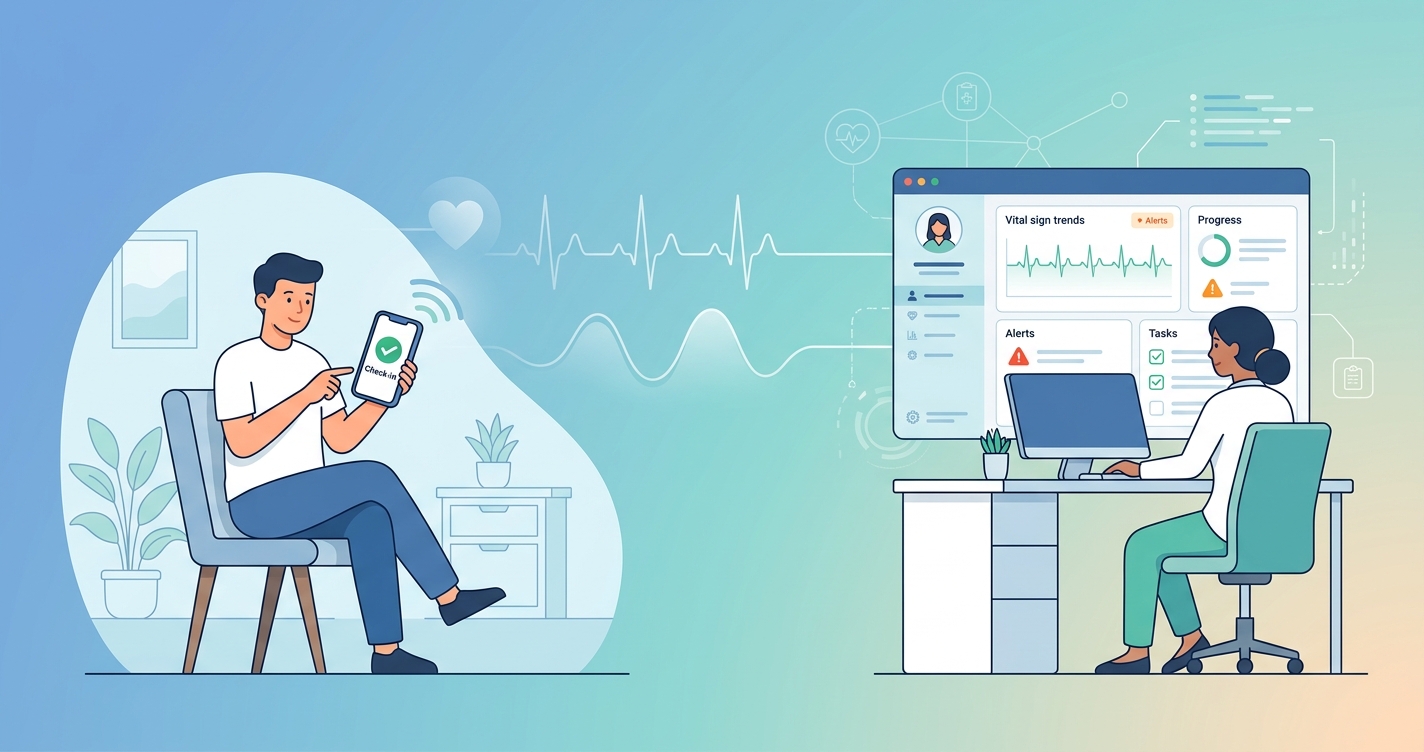
Build chronic care program contactless planning has shifted from a product conversation to an operating-model conversation. Chronic care leaders already know that heart failure, COPD, diabetes, and multimorbidity drive a disproportionate share of utilization. What they are trying to solve now is simpler: how do you create daily or monthly patient visibility without mailing more hardware, overloading nurses, or creating another workflow that patients abandon by month two? Contactless monitoring has become interesting because it changes the unit economics of engagement. It asks whether the most scalable chronic care program is the one that gets the richest stream of device data, or the one that more patients will actually complete.
"People with multiple chronic conditions account for 71% of all health care spending and 93% of Medicare spending." — Agency for Healthcare Research and Quality, Multiple Chronic Conditions Chartbook
Why build chronic care program contactless models now
The case for a contactless chronic care program starts with burden. Traditional remote monitoring can work well for selected cohorts, but shipping cuffs, scales, pulse oximeters, and replacement devices adds real cost before clinical value even appears. The friction does not stop with procurement. Staff still have to train patients, troubleshoot connectivity, and chase missing readings.
That is why many care teams are rethinking program design around the patient's existing phone or tablet. A 2022 Journal of Medical Internet Research meta-analysis led by Donato Giuseppe Leo, Benjamin J. R. Buckley, Mahin Chowdhury, Stephanie L. Harrison, Masoud Isanejad, Gregory Y. H. Lip, David J. Wright, and Deirdre A. Lane found that interactive remote patient monitoring across chronic conditions reduced mortality and improved blood pressure and glycated hemoglobin outcomes. The paper was not about contactless monitoring specifically, but it reinforced the core operating lesson: steady patient participation matters more than theoretical feature depth.
For contactless monitoring, that point is even sharper. The promise is not that a camera-based check-in replaces every clinical tool. It is that low-friction check-ins may widen coverage across large chronic populations, especially when the program needs more consistent touchpoints than symptom surveys alone can provide.
| Program design question | Device-heavy chronic program | Contactless-first chronic program |
|---|---|---|
| Patient setup | Requires shipping, pairing, charging, and maintenance | Usually starts with a phone or tablet already in the home |
| Main operational burden | Logistics and tech support | Patient onboarding, scan completion, and escalation workflow |
| Best fit | Smaller high-acuity cohorts needing specialty peripherals | Broader chronic populations needing frequent low-friction check-ins |
| Data collection pattern | Often richer per patient, but more fragile operationally | Lighter per check-in, but potentially easier to sustain |
| Staffing focus | Device rescue plus clinical outreach | Clinical triage, engagement, and care-plan adjustment |
| Financial logic | Higher cost per enrolled patient | Lower friction across a larger covered panel |
A good chronic care leader usually lands in the middle. The goal is not to eliminate every device. It is to reserve hardware for patients who truly need it, while using contactless monitoring to make the rest of the panel visible between visits.
The operating model behind a contactless chronic care program
When organizations try to build around contactless monitoring, the technology is usually the easy part. The harder work is operational.
A durable program usually includes five pieces:
- a clearly defined target population, such as heart failure after discharge, COPD patients with recent exacerbations, or diabetes patients with poor engagement
- a monitoring cadence that fits the condition instead of forcing the same schedule on everyone
- escalation rules that tell nurses what trend changes matter and what can wait
- reimbursement logic tied to CCM, RPM, APCM, or value-based contracts
- a patient workflow simple enough to survive real life, not just a demo
CMS policy is pushing the market in that direction. In the 2025 Medicare Physician Fee Schedule final rule, CMS added Advanced Primary Care Management codes G0556, G0557, and G0558. Those APCM codes do not replace every chronic care workflow, but they show where reimbursement is moving: toward longitudinal, team-based management for patients with one or more chronic conditions. That matters because contactless programs work best when they are treated as care infrastructure rather than a standalone gadget.
1. Start with a population, not a feature list
Most weak programs begin with a technology decision. Better programs begin with a utilization problem.
For heart failure, the question may be how to spot decompensation earlier after discharge. For COPD, it may be how to track respiratory stability between visits without expecting every patient to manage several devices. For diabetes, it may be how to support regular engagement when the patient already has enough treatment complexity.
A contactless model makes the most sense when the organization is trying to increase touchpoint frequency across a broader panel, not when it needs a specialty sensor for every patient.
2. Define what the check-in is supposed to do
This is where teams get sloppy. A daily scan is not useful just because it exists.
A contactless check-in can serve different jobs:
- establish baseline stability
- flag trend drift before symptoms trigger an urgent visit
- support monthly CCM outreach with fresher data
- help prioritize which patients need a nurse call today
- reinforce routine and self-awareness in patients who disengage easily
Those are different use cases. A program that treats them as the same usually ends up with noisy alerts and low staff confidence.
3. Build escalation rules before launch
Programs fail when nurses receive data without a response model. The escalation framework has to be designed before enrollment starts.
That framework usually includes:
- what constitutes a baseline change for the enrolled condition
- how many missed check-ins matter, and for whom
- which signals trigger same-day outreach versus standard follow-up
- when the case moves from care management to primary care, cardiology, pulmonology, or ED referral
- how the team documents intervention and closes the loop
This is what turns monitoring into chronic care management instead of passive data collection.
Industry applications where contactless monitoring fits best
Heart failure programs
Post-discharge heart failure programs are often the clearest fit because the readmission risk is immediate and expensive. A 2025 Medicare chronic disease cohort analysis of a remote patient care program reported a $1,302 reduction in annual total cost of care per patient and a 27% reduction in hospitalizations. Contactless monitoring will not reproduce those exact numbers on its own, but it fits the same economic logic: earlier visibility can prevent expensive deterioration.
COPD management
COPD programs need frequent touchpoints, but adherence is hard when the workflow depends on multiple devices and symptom diaries. A contactless model can support lighter routine monitoring while reserving more intensive tools for the sickest respiratory patients. There is also relevant adjacent evidence: work published through the European Respiratory Society has explored contactless monitoring during sleep for predicting COPD exacerbations, which shows why the field is paying attention to lower-burden physiologic surveillance.
Multimorbidity and value-based care
This may be the strongest use case. AHRQ's spending data explains why. Patients with multiple chronic conditions account for most Medicare spending, and those patients rarely fit clean disease-specific pathways. A lighter monitoring layer can help case managers cover larger panels and sort outreach based on who is drifting off baseline.
If you want to compare this design logic with adjacent chronic care workflows, see our posts on How Value-Based Care Organizations Use Daily Vitals Data and How CCM Programs Use Contactless Vitals for Monthly Check-Ins.
Current research and evidence
A few sources are shaping how serious buyers think about this category.
First, the AHRQ Multiple Chronic Conditions Chartbook remains one of the clearest framing documents for the economics of chronic care. When 93% of Medicare spending is tied to patients with multiple chronic conditions, even modest improvements in surveillance and outreach matter.
Second, the 2022 JMIR meta-analysis by Leo, Buckley, Chowdhury, Harrison, Isanejad, Lip, Wright, and Lane gives chronic care programs a broad evidence base for interactive monitoring. The authors found reduced mortality and better blood pressure and glycated hemoglobin outcomes, while also showing that adoption and acceptability were generally favorable.
Third, CMS has made longitudinal care management more central, not less. The 2025 APCM codes are important because they recognize that patients with chronic disease need structured monthly management, documentation, and coordination. Contactless monitoring fits that shift when it feeds a real care process instead of sitting outside it.
Fourth, rPPG and contactless vital-sign research has matured quickly. A 2024 review of remote photoplethysmography for health assessment described smartphone- and camera-based measurement as a low-cost, noninvasive way to estimate heart rate, respiratory rate, heart rate variability, oxygen saturation trends, and related biomarkers. That does not mean every workflow is production-ready for every cohort. It does explain why chronic care buyers are taking the category seriously.
What a practical build plan looks like
A contactless chronic care program is usually strongest when it is built in phases.
Phase 1: choose the initial cohort
Start where the cost of clinical drift is high and the current workflow is messy. Recent discharges, heart failure, COPD, and multimorbid Medicare populations are common starting points.
Phase 2: define cadence and staffing
Some populations need daily touchpoints. Others need several check-ins per week or a structured monthly rhythm inside CCM. The monitoring plan should follow clinical risk and staffing capacity, not wishful thinking.
Phase 3: set enrollment and activation metrics
Do not wait six months to discover the workflow is too hard. Track enrollment-to-activation rate, week-one completion, 30-day retention, escalation volume, and nurse time per active patient.
Phase 4: compare against the actual alternative
The real comparison is not contactless monitoring versus perfect care. It is contactless monitoring versus symptom-only outreach, or versus a device stack with high dropout and heavy support cost.
The future of contactless chronic care programs
The next wave will not be won by the platform with the longest list of measurable signals. It will be won by the program that creates reliable operational visibility without exhausting patients or staff.
Three things look likely from here:
- chronic care programs will split monitoring pathways by acuity, using specialty devices for narrower cohorts and contactless check-ins for broader panel coverage
- reimbursement and care-management models will keep favoring longitudinal coordination instead of episodic outreach
- buyers will judge monitoring tools by retention, activation, nurse efficiency, and avoided utilization, not by novelty alone
That shift is healthy. Chronic care programs do not need more dashboards. They need workflows patients will keep using, and signals care teams know how to act on.
Frequently asked questions
What does it mean to build a chronic care program around contactless monitoring?
It means designing the program's patient engagement, staffing, escalation, and reimbursement workflow around low-friction camera-based or contactless check-ins rather than assuming every patient needs mailed hardware.
Which chronic care populations fit contactless monitoring best?
Heart failure, COPD, diabetes, post-discharge populations, and multimorbid Medicare panels are common starting points because they need regular touchpoints and often struggle with device fatigue.
Does a contactless program replace all traditional RPM devices?
Usually no. The strongest model is often mixed. Contactless monitoring can widen participation across a larger panel, while specialty peripherals stay reserved for patients who need more intensive measurement.
How should buyers evaluate a contactless chronic care program?
Look at activation rate, 30-day and 90-day retention, nurse time per active patient, escalation quality, and downstream utilization. Those measures tell you more than a product demo does.
For chronic care organizations, the strategic question is no longer whether more monitoring is possible. It is whether the monitoring model is light enough to scale. That is the opening for platforms such as Circadify's chronic care management solution: a way to build longitudinal visibility into chronic care workflows without adding another box of hardware to every patient's kitchen table.