How ACOs Monitor High-Risk Patients Between Visits
An analysis of how ACOs monitor high-risk patients between visits using daily vital signs, risk stratification, and low-friction remote monitoring workflows.
How ACOs Monitor High-Risk Patients Between Visits
ACO high risk patient monitoring has become a practical question, not a future-facing one. Accountable Care Organizations are paid to keep expensive, fragile patients stable between visits, yet the patients who need the most attention are often the ones least likely to wear another device, open another portal, or remember another manual check-in. That gap between office encounters is where avoidable ED visits, readmissions, and rising total cost of care usually show up first.
"The long-term evidence suggests that ACOs can generate larger savings over time, especially when they build the operational infrastructure to manage risk." — J. Michael McWilliams, MD, PhD, Harvard Medical School, JAMA, 2023
ACO high risk patient monitoring depends on what happens between appointments
High-risk patients rarely deteriorate on schedule. A patient with heart failure may start breathing faster over three days. A patient with COPD may show rising resting heart rate before symptoms become obvious. A frail older adult with diabetes may look stable at discharge, then drift off course a week later because medication changes, poor sleep, infection, or dehydration push multiple conditions at once.
That is why between-visit monitoring matters so much in accountable care. In a 2023 JAMA analysis, J. Michael McWilliams and Laura Ouayogode found that MSSP ACO formation was associated with a mean reduction of $142 in annual per-patient spending over three years and $294 over six years, with estimated Medicare savings of $4.1 billion to $8.1 billion from 2012 to 2019. Those savings did not come from one dramatic intervention. They came from better management of high-risk populations over time.
CMS's 2024 MSSP update shows the scale of the opportunity: 480 organizations participating and more than 10.8 million people in traditional Medicare aligned to ACO initiatives. At that size, the central operating problem is straightforward. How do care teams know who is getting worse before claims data catches up?
| Monitoring question for ACOs | Visit-based model | Between-visit model with daily vitals |
|---|---|---|
| Who needs outreach today? | Based on last visit, diagnosis list, and staff intuition | Based on current physiologic trends and risk flags |
| When does deterioration become visible? | Often after symptoms worsen or utilization occurs | Often 24-72 hours earlier through trend changes |
| Which patients stay engaged? | Usually the most organized and tech-comfortable | Broader engagement when check-ins are low-friction |
| What does the care manager see? | Sparse snapshots | Continuous trend data |
| What drives cost control? | Retrospective utilization review | Earlier intervention before acute events |
| What scales across a large attributed panel? | Manual calls and periodic visits | Software-driven prioritization with clinical review |
The strongest ACO workflows usually combine three things:
- Claims and EHR data to identify baseline risk
- Frequent outreach from care managers for patients with complex needs
- Physiologic monitoring that reveals who is drifting before the next scheduled touchpoint
Which patients ACOs watch most closely
Not every attributed patient needs the same monitoring intensity. ACOs usually focus their between-visit attention on patients who combine clinical complexity with utilization risk.
Common high-risk groups include:
- Recent hospital discharges, especially after heart failure, COPD, or pneumonia admissions
- Patients with multiple chronic conditions and polypharmacy
- Frail older adults with mobility or cognitive barriers
- Patients with frequent ED use over the prior 6 to 12 months
- Patients with hypertension, diabetes, or heart failure whose control has been unstable
- Members with documented gaps in primary care follow-up or social support
This is where remote monitoring becomes useful, but only if patients actually participate. Donato Giuseppe Leo and colleagues reported in a 2022 JMIR systematic review and meta-analysis of 96 studies that interactive remote patient monitoring was associated with lower mortality and better blood pressure and glycated hemoglobin outcomes, while patient satisfaction and adherence were generally good. The point is not that every monitoring program works. It is that consistent monitoring creates a better chance to intervene early.
Why respiratory rate and trend data matter between visits
Many between-visit programs still center on symptoms and sporadic blood pressure readings. That leaves a blind spot. Subtle physiologic drift often appears before a patient says they feel worse.
Research keeps pointing back to respiratory rate as one of the earliest warning signs. A 2023 scoping review on respiratory rate as a predictor of clinical deterioration found that abnormalities in respiratory rate often precede other visible signs of decline, which helps explain why early warning systems weight it so heavily. For ACO populations managing heart failure, COPD, infection risk, or frailty, that matters.
Care teams are usually looking for pattern change, not one dramatic number:
- Resting heart rate creeping up over several days
- Respiratory rate rising from a patient's baseline
- Heart rate variability shifting in a way that suggests physiologic stress
- Daily check-ins missed by a patient who is usually consistent
- A cluster of small changes after discharge or medication adjustment
That is a better fit for accountable care than episodic monitoring alone. ACOs are not just trying to document vitals. They are trying to spot avoidable deterioration before it turns into a claim.
How ACO workflows use monitoring data in practice
High-risk patient monitoring in ACOs usually looks less glamorous than vendor decks suggest. It is mostly a workflow problem. A nurse care manager or care coordinator starts the day with too many attributed patients and not enough time. The job is to decide who needs attention first.
A workable between-visit model tends to follow this sequence:
Risk stratification sets the initial watch list
Claims, diagnoses, prior admissions, medication burden, and social risk factors identify the population most likely to benefit from closer observation.
Daily or near-daily check-ins create fresh signal
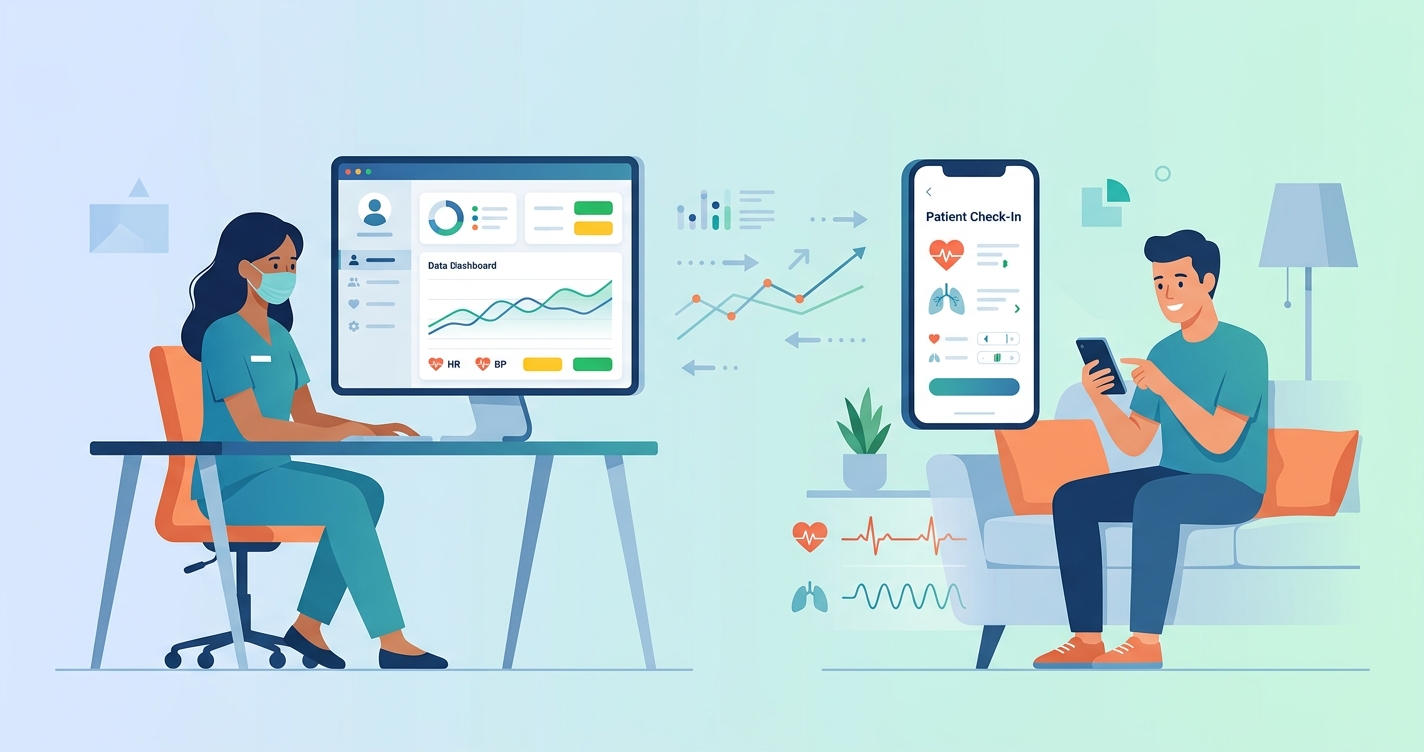
A low-friction camera-based scan, blood pressure reading, symptom prompt, or short outreach interaction creates new data between visits. For many ACOs, the real operational advantage is not one device versus another. It is reducing the amount of patient effort required to produce signal.
Dashboards rank patients by change, not just by diagnosis
A patient with heart failure is high risk on paper. A patient with heart failure whose respiratory rate rose for three consecutive days is high risk today. That distinction is what lets care managers prioritize intelligently.
Outreach focuses on the patients whose status changed
Instead of calling every patient on a static schedule, teams can work the patients whose data suggests trouble: medication confusion, worsening shortness of breath, low adherence, or a need for urgent primary care follow-up.
Escalation stays inside the network when possible
The value for ACOs comes when concerning trends lead to a same-day nurse call, medication adjustment, telehealth review, home health escalation, or quick clinic slot instead of an ED visit.
What the evidence says about remote monitoring for chronic populations
The literature is mixed in the way real healthcare evidence usually is, but the broad direction is clear: monitoring works best when it is paired with response workflows and sustained participation.
A 2021 systematic review in BMC Primary Care on remote monitoring systems for chronic diseases in primary care concluded that remote monitoring improved disease control and care management in several chronic conditions, while also noting that implementation and workflow design heavily influenced results. That lines up with what ACO operators already know. Data by itself does not save money. Timely action does.
The same lesson appears in accountable care economics. McWilliams and Ouayogode's long-run MSSP analysis suggests ACO savings deepen over time as organizations get better at the mechanics of population management. High-risk patient monitoring fits that pattern. Early programs tend to be manual and uneven. Mature programs get better at matching the right level of monitoring to the right patient and routing abnormal findings into existing care management teams.
Where contactless monitoring fits for ACO populations
Device fatigue is a real problem in chronic care. Patients with multiple conditions are often handed cuffs, scales, pulse oximeters, wearables, and portal logins all at once. Some use them faithfully. Many do not.
That is why contactless monitoring is drawing attention in accountable care. A brief camera-based check-in can lower the friction for patients who resist wearables or struggle with setup, charging, and syncing. For high-risk populations, that matters more than novelty. Better participation gives ACOs more complete coverage of the patients they are already financially responsible for.
For chronic care organizations, a contactless model is especially useful when the goal is to support:
- Heart failure surveillance after discharge
- COPD monitoring in patients who do not tolerate wearables well
- Daily chronic care check-ins for older adults at home
- Broader panel coverage without shipping and replacing hardware at scale
- Programs that need trends more than one-time readings
Readers looking at adjacent chronic care use cases may also want to see our analysis of how contactless monitoring helps heart failure patients at home and how value-based care organizations use daily vitals data.
Current research and evidence
Several findings are especially relevant for ACO leaders evaluating between-visit monitoring strategy:
- J. Michael McWilliams and Laura Ouayogode (JAMA, 2023) found that MSSP ACOs were associated with lower annual per-patient spending over both three-year and six-year horizons, with savings increasing over time.
- CMS reported that 480 ACOs joined CMS accountable care initiatives in 2024, covering more than 10.8 million people in traditional Medicare. That scale makes automated prioritization and workflow efficiency essential.
- Donato Giuseppe Leo, Benjamin J.R. Buckley, Mahin Chowdhury, and colleagues (JMIR, 2022) found that interactive remote patient monitoring reduced mortality and improved some chronic disease measures, while patients generally reported good satisfaction and adherence.
- The 2023 respiratory-rate scoping review found that respiratory abnormalities often precede other signs of deterioration, which is why between-visit monitoring programs keep coming back to rate and trend capture.
- The BMC Primary Care systematic review on remote monitoring in primary care found that implementation quality and care-team response determine whether monitoring translates into better outcomes.
None of this means an ACO should monitor everyone the same way. It means high-risk patient monitoring works best when the monitoring burden stays low, the data arrives frequently, and someone owns the next step.
The future of ACO high risk patient monitoring
The next phase will probably be less about adding more gadgets and more about making monitoring fit routine care management. ACOs already have attribution files, risk models, and care managers. What many still lack is a dependable between-visit signal that covers enough of the high-risk population to change daily operations.
Three shifts seem likely:
Monitoring will move from episodic to baseline-aware
Programs will care less about one isolated reading and more about whether a patient's personal baseline is changing.
Low-friction capture will matter more than hardware sophistication
If a simpler workflow gets twice as many high-risk patients to check in, it usually creates more value than a richer dataset from a small compliant subset.
ACO and chronic care workflows will merge more tightly
Between-visit monitoring will increasingly feed the same nurse outreach, transitional care, and escalation pathways that ACOs already run. The technology layer will matter, but the workflow layer will matter more.
Frequently asked questions
How do ACOs monitor high-risk patients between visits?
Most ACOs combine risk stratification, care manager outreach, and remote monitoring. The goal is to identify which patients are worsening before the next office visit. Daily or near-daily vital sign trends, symptom check-ins, and post-discharge follow-up are the core tools.
Which patients are usually considered high risk in an ACO?
High-risk patients typically include recent hospital discharges, people with multiple chronic conditions, patients with prior ED or inpatient utilization, frail older adults, and members whose disease control has been unstable.
Why is daily vital sign data useful for accountable care organizations?
Daily data gives ACO teams a much earlier view of deterioration than visit-based care alone. It helps care managers prioritize outreach, intervene sooner, and avoid some emergency visits or readmissions that raise total cost of care.
What makes contactless monitoring relevant for ACOs?
Contactless monitoring lowers the burden on patients because it can use an existing phone or tablet instead of another wearable device. That can improve participation in between-visit monitoring, especially for older adults and patients managing several conditions at once.
For ACOs, the hard part is not identifying high-risk patients on paper. It is keeping enough visibility between visits to act before small physiologic changes turn into expensive events. That is where lower-friction monitoring models are starting to matter. Solutions like Circadify's chronic care monitoring approach are aimed at that exact gap: giving care teams a simple way to capture more frequent patient signal without piling more device work onto already-burdened populations.